View another treasure of Milan's art and history:
|
Church of San Carlo at the Lazzaretto
|
|
|
Search by name:
|
 Mostly represented styles: Renaissance Mostly represented styles: Renaissance
The Church of San Carlo at the Lazzaretto owes its name to the fact that it was originally located at the center of the Lazzaretto, the structure built just outside the city walls to accommodate the sick during plague epidemics.
HISTORY
The history of the Church of San Carlo at the Lazzaretto cannot be separated from that of Milan's Lazzaretto, the Lazzaretto of San Gregorio. This was built between 1488 and 1513 just outside the city walls, near the Eastern Gate, in a context that remained agricultural until the second half of the nineteenth century.
It essentially consisted of an enormous square portico measuring almost 400 meters per side, surrounded by a moat. All sides of the portico led to the cells housing the sick who lived in the lazaretto, isolated from the rest of the city.
The first version of the church, probably made of wood, was built between 1520 and 1560 in the center of the Lazzaretto square. The current church was built between 1580 and 1591, designed by Pellegrino Pellegrini. The original dedication was to Saint Mary of Health, although it was referred to as the Church of San Gregorio, like the Lazzaretto of which it was part.
In its initial version, the church had no walls, allowing the sick to follow the service from their cells.
It was built in a sober late-Renaissance style and in accordance with the dictates of the Counter-Reformation, with the exception of the general structure, with radial symmetry, necessary due to the church's unique function.
The church subsequently had a very troubled life.
After the plague epidemic of 1630, the one recounted in The Betrothed by Alessandro Manzoni, the Lazzaretto and the church were abandoned. The church was used only once a year, on Pentecost Monday.
The church underwent its first renovation in 1795.
In 1796, the French, who occupied Milan, transformed the Lazzaretto into barracks and the church into a powder magazine. It was later transformed into the Altar of the Fatherland, with inside the Statue of Liberty in place of the altar.
After the Napoleonic era, the church, now walled up and accessible only through an opening in a wall, was used as a barn, stable, and icehouse until 1881, when the Lazzaretto was purchased by the Banco di Credito Italiano (Italian Credit Bank) with the aim of using the space it occupied for housing projects, with the condition, however, of preserving the church.
In 1883, the Parish of Santa Francesca Romana decided to purchase and renovate the small church, in order to safeguard it and provide more space for its rapidly growing number of parishioners. This was also thanks to the special price it received. During these renovations, the perimeter walls were redone, the windows were reduced from six to four, and they were moved under the arches, rather than halfway up the wall as they had been previously. A lantern was also added above the dome, and a sacristy, later raised, was added on the opposite side. These last two interventions perhaps somewhat marred the austere simplicity of the initial design.
The dedication was also changed, becoming "San Carlo al Lazzaretto," although for many it was known as the "Church of San Carlino" (Carlino = small Carl). The church was then inaugurated in this new guise on November 4, 1884, on the occasion of the third centenary of the death of St. Charles.
A new altar was then placed in the church, no longer in the center but on the north side.
In 1893, the side altar dedicated to Our Lady of Pompei was erected.
In 1896, the gate that still surrounds the entire church was added.
In 1914, the interior was decorated with the gilded stucco that is still visible today, and the other side altar, dedicated to Saint Joseph, was erected.
In 1923, a first organ was installed, but it was destroyed during the bombings of 1943 and was immediately replaced with the current one.
The church underwent further major restoration work in 1984, on the occasion of the fourth centenary of the death of Saint Charles.
Between 2015 and 2017 the church underwent further in-depth restoration work.
STRUCTURE
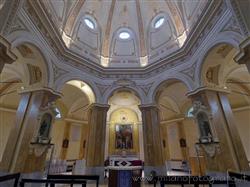
The church is in late Renaissance style and has an octagonal radial symmetry. Except for the side where the sacristy was added, each wall has a Serlian window structure, with a central arch supported by two stone columns with Doric capitals. In the lunettes of four of these arches is a hemispherical window. The edges of the octagon are highlighted by the pillars, which togheter with the columns were originally the only elements present, as the walls were added only later.
At the center of the roof is the central dome, surrounded externally by a small tiburium, on each side of which is an oculus.
At the center of the dome is the lantern, which has the exact shape of the dome on a smaller scale.
Inside, the central space under the dome is surrounded by the eight rectangular pillars that support the dome. The surrounding circular space is divided into spans with pavilion vaults. The arches at the base of the dome are very wide and are stylistically lightened by the coffered intrados with stucco decorations inside.
The arches are separated from the dome by an entablature with a band of stucco decorations.
The dome features a large lunette containing an oculus in each segment.
Two of the columns contain niches with rich stucco frames containing statues of the Madonna (left) and Saint Anthony of Padua (right).
The stucco decorations that emphasize and enrich all the interior structures date back to 1910.
Above the arch opposite the entrance, within a stucco scroll, the inscription "Humilitas," the Borromeo family's motto, is clearly visible.
The mosaic floor was created in 1938. At the center is a large star containing the inscription "Humilitas."
The altar is set against the wall opposite the entrance, surrounded by a golden mosaic with, at the top, the inscription "Humilitas" again in stucco. The altarpiece depicts Saint Charles Visiting the Plague Victims. It is known to have been painted in 1884, but its author is unknown.
On the left wall hangs a painting of the Madonna of Pompeii. In it, the Madonna, with the Child on her lap, hands the rosary to Saint Dominic and Saint Catherine of Siena.
On the right wall is a painting by a certain Tornaghi depicting the death of Saint Joseph.
If you are interested in a guided tour of this monument send an email!
Categories: Churches / Religious buildings
Largo Fra Paolo Bellintani, 1, 20124 Milano MI |
Further pictures of the Church of San Carlo at the Lazzaretto in the section Photography |