Show an other tourist attraction of the Biella area:
|
Biella- Church of St. James
|
|
|
Serch by name what visit in the Biella area: |
 The Church of San Giacomo is the oldest building in the Piazzo quarter. The Church of San Giacomo is the oldest building in the Piazzo quarter.
HISTORY
The oldest references to it date back to 1180, although it is unknown whether any of that original version of the church has survived to the present day.
The current building, in its general structure, is the one consecrated in 1227.
The bell tower was built after the façade, as evidenced by the fact that the façade's decorations were incorporated into it.
This church has also undergone significant modifications over the centuries.
In the sixteenth century, the interior floor was raised by two meters, both to give greater stability to the structure and to create twelve burial spaces beneath the floor.
In the seventeenth century, the small portico in front of the entrance was added.
STRUCTURE
From the outside, practically only the façade and the bell tower of the church can be seen, as other buildings are built against it to the right. The back overlooks the steep eastern slope of the hill on which the Piazzo neighborhood is located, and from the small street below the church, it appears hidden behind a high wall. The left side can be glimpsed, as it faces a narrow courtyard, which is not generally accessible.
The façade is very simple. Completely plastered, it is divided vertically by thin pilasters into three sections corresponding to the internal division into naves and is enriched by three pinnacles and strings of small Gothic-era clay arches. Each section has an oculus, the central one being the largest. Note that the left oculus is located behind the bell tower, which, however, at that height is open to the façade. The small, late-16th-century portico in front of the single entrance is decorated both internally and externally with frescoes intended to simulate the presence of cornices and stucco. However, the external frescoes are now barely visible. The portico is considered a baptismal building because the first part of the baptismal rite took place there.
The bell tower is divided into levels marked by terracotta cornices with trefoil motifs. Each level has large mullioned windows on at least two sides. The central columns have terracotta capitals and support two round arches inserted into pointed arches. Note that the base of the bell tower, the only exposed brick part, opens outward on three sides through three Gothic arches.
The interior has a basilica plan and, as is often the case with medieval churches, presents evident irregularities: the naves narrow towards the presbytery, and the presbytery and the square apse slope to the left. The internal surfaces were decorated in 1862 in Neo-Gothic style by Delio Tessa, which can be confusing to the casual visitor. Unfortunately, it must be said that the church is extremely dark, as the windows are few and small. The naves are separated by clustered pillars, and the naves are covered by cross vaults.
On the counterfaçade is a large choir loft with a curved painted wooden balustrade. It houses a mid-nineteenth-century organ.
The church has only one side chapel. However, there are several altars.
On the right side, starting from the entrance, you will find:
- Altar of Blessed Agostino de Fango: It is dedicated to the Dominican friar Agostino de Fango, who died in 1493. The altar is recent, having been completed in 1878. Above the altar, in an urn, the remains of the blessed are preserved. The altarpiece was painted in 1877 by Luigi Ciardi and depicts the blessed.
- Altar of the Crucifix: It features stucco work executed in 1863 by Tommaso and Alessandro Fussotti of Mongrando.
- Altar of the Madonna of Oropa: Located at the head of the right nave, it was built from local, dark stone between 1706 and 1716 by Giovanni Galliari, Carlo Francesco Aureggio-Termine, Giovanni Battista and Carlo Guglielminotti. The retable's structure is typically Baroque and embellished with large gilded decorations. At the center is a niche containing a painted and gilded wooden statue of the Madonna of Oropa, created by an anonymous artist in 1623. The base of the altar houses a Pietà from the early seventeenth century.
On the left side, still starting from the entrance, are:
- Baptismal Chapel: The baptismal font dates back to 1728 and is the work of Andrea Guglielminotti da Favaro for the stone basin, and of Pietro Giuseppe Aureggio for the carved walnut pyramid resting on it. The large altar, formerly dedicated to Saint John the Baptist, is the work of Giovanni Vaglio di Pettinengo.
- Chapel of Our Lady of the Rosary: The altar dates back to the early nineteenth century. In the center is a large niche containing an eighteenth-century statue of the Madonna from the no longer existing Church of San Domenico. It is attributed to Carlo Francesco and Pietro Giuseppe Aureggio. The Mysteries of the Rosary, hanging on the interior walls of the niche, are attributed to Lorenzo Giuseppe Vigliani.
- Altar of San Carlo: It is located at the head of the left nave. The dedication to St. Charles dates back to 1628; previously, the altar was dedicated to Our Lady of the Assumption, as evidenced by the remains of the frescoes on the wall behind the painting in a sumptuous gilded wooden frame depicting San Carlo. Note that the painting's frame features the Coda family coat of arms at the top.
The walls also feature other works of art of considerable importance:
- Madonna and Child with Saints Jerome, Francis of Assisi, Lucy, and Michael: A sixteenth-century canvas by an anonymous artist. It is located on the right wall, at the level of the secondo span of the presbytery.
- Madonna and Child with Saints Jerome and Abbondio: Located on the left wall, at the level of the presbytery. The work's attribution is uncertain. The frame has an architectural structure, with the main canvas placed within an arch. There is also a predella, depicting episodes from the life of Saint Abbondio: the saint's mass, attended by a father and his young son, a lunch attended by many children, and the resurrection of a child by the saint.
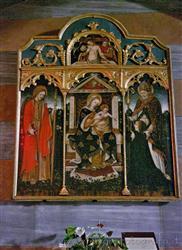
- Triptych by Daniele de Bosis: It is located on the right wall, at the level of the second span of the presbytery. This is the church's most important work of art. It was created in 1496 by Daniele de Bosis for the pictorial part and by Bernardino di Carpignano for the supporting structure in carved and gilded wood. At the center of the triptych is the Madonna and Child wearing a red dress and a blue cloak with gold floral motifs. In the left panel is Saint James wearing a gold-edged pilgrim's cloak. In the right panel, Saint Gotthard, dressed in pontifical robes with gold trim, is visible, presenting the patron, the jurist Giacomo dal Pozzo. Note that the halos are made of real gold. Finally, in the cymatium is a Pietà with Our Lady of Sorrows and Saint John the Evangelist.
The triptych, with its profusion of gold and refined execution, is a significant example of Novara art in late Gothic style.
The presbytery is separated from the nave by a marble balustrade made in 1746 by the Albuzzi brothers of Como.
The Baroque-style high altar is made of carved, painted, and gilded wood. The current version is the result of a restoration that took place in 1773. The altarpiece, of unknown author and set within a gilded wooden mixtilinear frame and dated 1791, depicts the martyrdom of Saint James. The crucifix above the altar is a 1748 work by Carlo Francesco Aureggio, while the baldachin by Lorenzo Vigliani dates back to 1815.
The choir stalls date back to 1697-1698 and are attributed to the Tampia brothers of Mortigliengo.
Also worthy of mention are the carved wooden pulpit created by Giovanni Marchisio in 1756 and the pews, which have noble coats of arms carved on the backs, still partially visible.
Categories: Places of historical value of artistic value
Piazza S. Giacomo, 2, 13900 Biella BI |
Church of St. James: Further pictures in the section Photography |