Show an other tourist attraction of the Biella area:
|
Biella- Church of Saint Nicholas
|
|
|
Show to visit in the Biella area: |
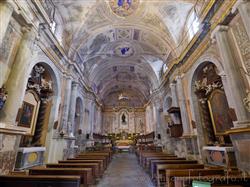 The Church of San Nicola is located in the Vernato district and is dedicated to Saint Nicholas of Tolentino, an Augustinian friar born in 1245. The Church of San Nicola is located in the Vernato district and is dedicated to Saint Nicholas of Tolentino, an Augustinian friar born in 1245.
HISTORY
The history of the church is linked to that of the Confraternity of of Saint Nicholas, one of the oldest in Biella. It is unknown when it was founded, but it certainly existed as early as 1553, the year in which the church that was its original headquarters, on what is now dei Conciatori street, had to be expanded because it was no longer sufficient. This means that the confraternity must have back then already existed for several decades. Unfortunately, a fire destroyed the archives on the night of the saint's feast day in 1690, making it impossible to reconstruct the detailed history of the confraternity and its churches.
It is worth remembering that the Confraternity of Saint Nicholas long had great importance in Biella, because, even up until the first half of the twentieth century, it was involved not only in catechism but also in education, healthcare and nursing.
In any case, by the seventeenth century, the church, the original seat of the brotherhood, had once again become inadequate, despite expansions. The construction of the church described on this page began in 1646, so that it could serve as a suitable new headquarters. By 1661, the walls had certainly been completed, including the first two side altars. The façade, however, was built between 1721 and 1783.
The bell tower was added only in 1836.
In the second half of the twentieth century, the church unfortunately suffered several decades of neglect, resulting in the loss of many valuable works of art once housed within.
Fortunately, in this century it has returned to enjoy attention, particularly with the recent complete restoration of the façade.
STRUCTURE
Of the Church of Saint Nicholas, practically only the facade can be seen, as it is only partially flanked by narrow, inaccessible private courtyards, and behind it the nearest road is separated from the church by gardens and fields. Even the small bell tower, located at the rear right corner of the nave, is not visible. The façade is late Baroque, but already reveals clear Neoclassical elements. It is very sober, with two orders punctuated vertically by columns with Ionic capitals superimposed to pilasters. At the base, the columns and pilasters rest on a high rough stone plinth. The two orders are delimited at the top by multiple double cornices separated by a band of a more striking color. There is a single, central door, made of solid walnut, dated 1709 and framed by a granite portal with a triangular pediment. The façade apparently had provisions for two side doors, but these are actually bricked up. Similarly, the upper order features three window frames, but only the central one is real. The façade ends at the top with a large elliptical pediment, echoed by a pediment of the same shape between the two tiers, above the main door, and even smaller ones above the false side doors and the large window.
The interior has a single nave, with a rectangular apse that essentially constitutes a simple continuation of the nave. The side walls are punctuated by pairs of columns superimposed to broad pilasters. These also divide the side chapels. The nave has a barrel vault with lunettes punctuated by large arches. The lunettes contain rectangular windows, allowing the church to be fairly well lit. The vault is separated from the walls by a thick trabeation. Almost all iternal surfaces are covered with neoclassical-style painted decorations. The surfaces are therefore divided into geometric frames and bands, with trompe l'oeil simulations of stucco relief with the form of grotesques and stylized plant elements. The columns and arches of the chapels are decorated to simulate marble.
At the center of the vault of each of the nave spans is an oval. The content of the first one is lost, while the second depicts the Assumption of Mary and the third the Assumption of the Risen Christ. These are the only human figures among the nave's decorations (created in 1860 by Carlo Artari).
The counterfaçade houses a large vestibule at the bottom, made of solid walnut like the door. Above it is a rare two-tiered choir loft (dating from 1816), made of painted wood. Unfortunately, the organ, built by Amedeo Ramasco in 1846, was not present at the time of the visit due to restoration.
The church has six side chapels, three on each side, all with the same structure: shallow, with a barrel vault and an entrance arch in faux gray marble.
On the left, starting from the entrance, are:
- Chapel of Saint Nicholas: The altar it houses was certainly already present in 1755. The altarpiece, attributed to Carlo Francesco Chiamorra, depicts the Miracle of Saint Nicholas.
- Chapel of the Holy Family: It houses a beautiful Baroque wooden altar by Pietro Antonio Serpentiere, whose wooden table was replaced with a marble one in 1908. The retable is composed of two large twisted columns with Corinthian capitals supporting an entablature with a Baroque pediment decorated with bouquets of flowers, cherub heads, and putti. Two more angels are depicted flying above the gilded frame between the two columns. Inside the frame hangs a painting of the Holy Family with Saint Anthony the Abbot, painted by an anonymous artist in 1634.
- Chapel of Saint Expeditus Martyr (Fig. 5): The sober marble altar dates back to 1901. The altarpiece dates back to the mid-nineteenth century and depicts the saint, patron saint of merchants, lawyers, and students, invoked for the completion of urgent matters. He tramples on a crow crying "Cras" and holds a cross with the word "Hodie." This is therefore a warning not to procrastinate.
The rural background is interesting, with a shepherdess tending a sheep while spinning wool. Perhaps a tribute to the wool industry, which was then very thriving in Biella.
On the right, starting from the entrance, are:
- Chapel of Suffrage (Fig. 3): This houses a beautiful carved wooden retable in which two flat fluted columns rest on a base and support a baroque pediment decorated with garlands and a cherub's head. Other cherub heads, acanthus leaves, and bunches of fruit decorate the outer edges of the two columns.
The large altarpiece depicts a Last Judgement with Saints, painted by an unknown artist in 1649. The canvas depicts Christ the Judge between Saint Nicholas and Saint Monica in the upper section, and the souls in Purgatory in the lower section. Note, at the feet of Saint Nicholas, the three crowns of royalty: of Christ, of Saint Monica and of Saint Nicholas himself. The scroll at the bottom left of the painting attests that the painting was commissioned by the female members of the Confraternity.
- Chapel of the Ascension of Jesus: The altar has the exact same structure as the one in the Chapel of the Holy Family. The only difference is the addition of a beautiful carved and painted wooden tabernacle, richly decorated. The altarpiece, by an unknown artist, dates back to the late seventeenth or early eighteenth century and depicts the Assumption of the Risen Christ into Heaven.
- Third chapel on the right: It is empty and contains only the door leading to the sacristy.
Between the second and third chapels is the wooden pulpit on the wall. It appears very simple today, because the panels decorated with fine reliefs have been stolen. The two cherubs sitting on the balustrade are not in their original position and were probably part of an altar (the one demolished in 1770?, see below).
The presbytery and choir are slightly raised above the nave, from which they are separated by a solid wood balustrade.
The choir was once, as was always the case in churches belonging to confraternities, completely separated from the presbytery by a large high altar that extended laterally to the side walls. The one in the Church of Saint Nicholas was a monumental pyramid-shaped altar created in the seventeenth century by Bartolomeo Termine. Unfortunately, in 1770, it was decided to demolish it and replace it with the current one, made of wood decorated to imitate marble and created by Pietro Antonio Serpentiere between the seventeenth and eighteenth centuries. Unfortunately, the frontal antependium depicting the souls in purgatory has been lost.
Above the altar hangs a circular crown-shaped canopy from 1814.
The choir, likely dating to the early seventeenth century and attributed to the Aureggio workshop, unfortunately suffered extensive damage during the decades of abandonment of the church in the second half of the last century. All the seats were lost, eaten away by humidity and woodworms, and all the numerous statues that once adorned it were stolen.
On the back wall of the choir, resting on shelves, are three wooden statues. The central statue is painted and depicts Saint Nicholas. At his feet are two little angels who seem to point to him. The other two are painted white to simulate marble and depict Saint Blaise (the one on the left) and Saint Augustine (the one on the right). Two other statues of angels flank the altar, and two more statues, an angel and a warrior saint (Saint Maurice or Saint Louis), are located in the nave. All these statues come from the original seventeenth-century altar, which was unfortunately demolished, and are therefore attributed to Bartolomeo Termine.
The Church of Saint Nicholas truly deserves further restoration work to restore also its interior to its former splendor. It is hoped that making the church known to a wider audience will help ensure that such work is carried out.
Categories: Places of historical value of artistic value
Costa Vernato, 13900, Biella, BI |
Church of Saint Nicholas: Further pictures in the section Photography |