View another tourist attraction around Milan:
|
Castelleone (Cremona, Italy): Church of St. Mary in Bressanoro
|
|
|
Show an other place around Milan worth a visit: |
 The Church of Santa Maria in Bressanoro is located just outside the town of Castelleone, surrounded by meadows and farmland. It represents an important example of early Renaissance architecture in the Lombardy of the Sforza family. The Church of Santa Maria in Bressanoro is located just outside the town of Castelleone, surrounded by meadows and farmland. It represents an important example of early Renaissance architecture in the Lombardy of the Sforza family.
HISTORY
A Church of Santa Maria had existed on the site since the Middle Ages. A convent run by the Friars Minor was later added. By the mid-fifteenth century, however, both the church and the convent had fallen into decay. The Sforza family, Dukes of Milan, then decided to entrust the complex to Blessed Amedeo Menesez de Sylva, a Franciscan of the Observance and a converted Jew born in Ceuta in 1431, a Spanish possession in Morocco. The friar was particularly esteemed by Bianca Maria Sforza, whose vow of pilgrimage to the Sanctuary of Guadalupe had been converted by Blessed Amedeo into a promise of assistance in the construction of the new church.
Construction of the new church (specifically dedicated to Our Lady of Guadalupe) and the adjoining convent began in 1461 and was completed in 1465. The portico, the bell tower and the choir, however, were added only in 1505, after the church was already completed.
The complex included the church, the old church, transformed into the personal oratory of Blessed Amedeo, the convent with three cloisters, two chapels (built in the first half of the seventeenth century and dedicated to Saint Francis and Saint Fermo) next to the entrance of the new church, and a small cemetery.
The Amadeite friars (the congregation of Reformed Franciscans founded by Blessed Amedeo in 1464) remained custodians of the complex until 1568, when the congregation was united by decree of Pope Pius V with the Observant Franciscans of the province of Brescia.
In 1810, following the Napoleonic reforms, the convent was suppressed. In the following years, the convent (with the exception of the part that now houses the custodian), the personal oratory of Blessed Amedeo, the two chapels next to the entrance and the cemetery were demolished.
In the mid-twentieth century, the church underwent extensive restoration work, restoring its original splendor. The church was closed to the public for a long time, but was reopened towards the end of the last century.
STRUCTURE
The church is built entirely of exposed brick. The general structure is a Greek cross, with a central square body with four square arms. A rectangular apse is furthermore added to the rear arm. The central body is covered by a dome surrounded by a tiburium. The secondary bodies are also covered by smaller domes, but in this case a normal roof is placed above them. The corners of the various bodies are are underlined by pilasters.
The bell tower is located at the rear, near the left side of the rear arm. The bellfry has a bifora on each side. Between the right and rear arms is what remains of the convent.
The facade is gabled, with an oculus at the center.
The entrance door is pointed, testifying to the fact that the church was built during the transition period between Gothic and Renaissance. In front of the main door is the portico, divided into three cross vaults and supported by four brick columns. The fact that it partially hides the oculus demonstrates that it was not part of the original design and was only added later.
Overall, the church's architecture is very severe, almost military. This characteristic supports the attribution of its design to Bartolomeo Gadio, an architect but also a man of arms and builder of war machines for the Duchy of Milan during the time of Bianca Maria Visconti.
The decorative element of the church's exterior is entirely entrusted to the terracotta decorations (also present inside) attributed to Rainaldo de Stauli and his workshop.
The façade is naturally the most decorated part. The lateral pilasters are covered with panels divided into spiral-shaped sections, featuring praying angels with their arms folded across their chests and decorative elements such as pairs of cups, acanthus leaves, stylized flowers, and the Sforza motto "DROIT SEMPER."
The decoration below the roofline is very rich: a band again featuring angels with their hands folded across their chests alternating with amphorae (?), a second band of decorative elements, and finally a third band of hanging arches with a cherub's head at the base of each arch.
Various bands of decorative elements surround the central oculus.
The portal's decoration is particularly rich. In addition to the innermost simple brick cornice, it comprises five different bands. Starting from the interior, there are: laurel wrapped in ribbons bearing two Sforza mottos, "A BON DROIT, SEMPER DROIT," little angels embracing a vine laden with bunches of grapes, a spiral motif, curled acanthus leaves and a simple fluted motif.
Clay decorations reproducing the various themes present on the façade are also present around the oculi of the tiburium and under its roof attachment, around some windows, under the roof attachment of the side arms on the front and sides, and under the biforas of the belfry (hanging arches with cherub heads at the base).
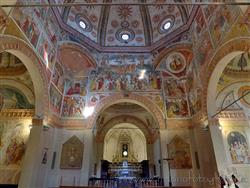
The structure of the interior mirrors what is seen from the outside. There is a central square body covered by an octagonal dome whose oblique sides rest on squinches. On each side of the square is a large arch leading to one of the secondary bodies, also square and covered by a circular dome.
Along the entire interior perimeter, with the exception of the choir, runs a thick band of terracotta decorations placed at the height of the attachments of the internal arches. It includes praying angels in the center, with two bands of spirals and acanthus leaves above and below. Clay decorations then emphasize the arches connecting the central body with the lateral ones, the arches of the squinches, and the bases of the domes of the lateral bodies. Sixteen aedicules are inserted into the squinches of the domes of the lateral bodies, each containing a terracotta statuette of an angel. Particularly beautiful is the bust of the Madonna and Child at the top of the arch leading into the presbytery.
The church's greatest treasure is represented by the numerous frescoes that cover a significant portion of the interior walls and were created in various periods. Generally, the narrative intent prevails over artistic quality, which, however, is adequate. Note that they are embellished with some relief details (gifts of the Three Kings, chalices of the Passion) and halos, most of which are decorated with gold leaf, although these have often been lost.
The frescoes in the central body, all located between the decorative terracotta band and the base of the dome and divided into panels like a comic strip, are dedicated to the life of Christ, from the Annunciation to the Crucifixion. It is unclear who painted them. The style is early Renaissance, with Gothic elements.
Note that the dome (Fig. 2) is also frescoed, but only with decorative elements, in particular with the sun with rays, symbol of the Visconti family, with the initials IHS inside, a reference to Jesus Christ. The ribs and oculi are highlighted by white bands with shoots of small red roses.
- Central body, west wall (larger picture): This is the wall you see when looking toward the entrance. It sows the first episodes of Christ's life.
The frescoes depict: Annunciation, Birth of Christ, Adoration of the Magi, Massacre of the Innocents, Baptism of Christ, Temptation of Jesus in the Desert, Washing of the Feet, Resurrection of Lazarus.
In the roundels above the squinches, from left to right, are Saint Bonaventure, Saint Clare, Saint Bernardino, and Saint Francis.
- Central body, north wall (Left wall): The frescoes depict Entrance to the Temple, The Last Supper, The Kiss of Judas (or the Capture of Jesus), Jesus before Caiaphas, Prayer in the Garden of Olives, and Jesus before Herod.
- Central body, south wall (right wall): Depicted are The Descent of Jesus into Limbo, The Resurrection of Jesus, The Three Marys at the Tomb, The Disciples on the Road to Emmaus, The Incredulity of St. Thomas, The Ascension, Pentecost, and The Last Judgement.
- Central body, east wall (The wall facing you as you enter): Depicted are The Crowning with Thorns, The Ascent to Calvary with the Cross, The Deposition, The Pietà for the Dead Christ, and The Crucifixion. The latter is the largest scene and the one that catches your eye as you enter the central body. Note how only Jesus is nailed to the cross; the thieves on either side are tied to it. This was a widespread practice in the late Middle Ages. Other interesting details include the angel near the head of the good thief, ready to carry his soul to Heaven, the little devil near the head of the bad thief, waiting to carry his soul to Hell, and the angels collecting in cups the blood of Christ flowing from his wounds.
In the roundels above the squinches, from left to right, are Saint James of the Marches, Blessed Amadeus, Saint Jerome, and Saint Louis.
In the two roundels above the entrance arch to the presbytery are the prophets Isaiah (left) and Jeremiah (right).
The four evangelists were originally depicted in the dome's squinches. Today, only St. Matthew and the (very damaged) St. Mark are still visible.
Left lateral body (Chapel of the Holy Spirit) (Fig. 3): The frescoes in this chapel date back to the late sixteenth century. The style is Mannerist, and the depictions adhere to the dictates of the Counter-Reformation.
The altar at the bottom wall features a wooden retable with an entirely gilded architectural structure. In the center is a large niche containing a statue of Saint Anthony of Padua. To the left of the altar is a depiction of the Conversion of Saint Paul, to the right of the Mary Magdalene.
The walls depict the twelve apostles, three pairs on the left wall and three on the right wall.
The dome depicts the four Evangelists and the four Doctors of the Church, each at the base of one of the segments, frescoed to create a tropé l'oeil architecture. The pendentives are also frescoed to suggest architectural elements. The upper part of the segments features decorative elements with plant-themed motifs, including, around the center of the dome, branches bearing various types of fruit.
In the lunettes on the side walls, two pairs of friars seem to be opening a curtain to reveal the balustrade of a terrace with the sky as a backdrop.
Finally, note how the window on the right wall is integrated into the trompe l'oeil representation of a tower.
Right lateral body (Chapel of the Blessed Virgin) (Fig. 4): The frescoes in this chapel are attributed to Giuseppe Pesenti, who painted them at the end of the sixteenth century.
The altar in the center of the bottom wall has the same structure as the one in the previous chapel, although the details are different. The statue in the display case depicts Saint Francis.
This chapel also makes extensive use of the trompe l'oeil technique. Behind the altar is a rich simulated curtain, while on the sides are depicted Saint Ambrose in episcopal robes (on the left) and Saint Liberata (on the right), both within simulated architectural structures.
On the left wall are depicted the Circumcision and Jesus among the Doctors, on the right wall the Death of Mary and the Assumption.
Here too, the segments of the dome were frescoed to simulate architectural structures. At the base of each segment is an episode from the life of Mary: Meeting of Joachim and Saint Anne, Presentation of Mary in the Temple, Marriage of Mary to Joseph, Annunciation, Meeting of Mary with Elizabeth, Journey to Bethlehem for the Census, and Nativity.
Against the left wall, in a protective case, is a fifteenth-century painted terracotta statue of a Madonna and Child, known as the Madonna of the Swallow.
To the left of the altar is a sarcophagus with an Ecce Homo between Saints Francis and Lawrence depicted on the lid.
Presbytery and Choir
Note, first of all, the two detached fifteenth-century frescoes hanging on either side of the entrance to the presbytery. The one on the left depicts a blessing pope, and the one on the right three young female saints. They were originally located on either side of the main entrance door.
The presbytery is separated from the main body by a polychrome marble balustrade. It is essentially undecorated. Note, however, the Serlian window on the left side.
The high altar is made of polychrome marble and is more recent than the church, having been built in the eighteenth century. At its center is an inlay depicting the Franciscan symbol.
The choir dates back to 1505, when the church was enlarged, and features a vault decorated with Visconti radiant suns and stylized plant elements. Note that it still has pointed arches. The lower part of the choir walls is occupied by the large stalls, arranged in two rows and made of solid walnut in 1505.
On the upper section of the back wall is a niche containing a statue of the Madonna crushing the dragon, created in the eighteenth century by Giuseppe Bertesi. Around the niche is a Baroque-style polychrome faux marble frame that, from the right distance, appears to constitute the retable of the high altar.
Finally, note the Ecce Homo on the right half of the entrance arch to the choir, which may date to the Renaissance.
Categories: Places of historical value of artistic value
Villa Guzzafame, 26012 Castelleone CR |
Further pictures of Church of St. Mary in Bressanoro in the section Photography |