View another tourist attraction around Milan:
|
Castelleone (Cremona, Italy): Sanctuary of Our Lady of Mercy
|
|
|
Show an other place around Milan worth a visit: |
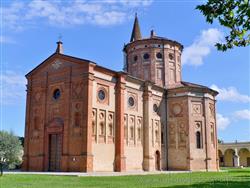 The Sanctuary of Our Lady of Mercy is located about one kilometer from the center of Castelleone, on the edge of a small park. The Sanctuary of Our Lady of Mercy is located about one kilometer from the center of Castelleone, on the edge of a small park.
It was built between 1513 and 1525 on the site where the Madonna had appeared to the peasant Domenica Zanenga in 1511, at the behest of the Community of Castelleone and was therefore born as a civic temple.
HISTORY
According to tradition, the Virgin Mary appeared to the peasant Domenica Zanenga for four days in May 1511. At the site of the miracle, the community of Castelleone decided to erect a sanctuary dedicated to the Madonna. It was built between 1513 and 1525 based on a design by Agostino de Fondulis. The bell tower was added in 1575.
In 1617, the sanctuary was entrusted to the Augustinian friars, who built the cloister and convent next to it in 1619. This was later suppressed by order of Joseph II, and the sanctuary passed into the hands of the secular clergy.
Between 1909 and 1910, to accommodate the growing number of pilgrims, the church was expanded to a design by engineer Francesco Valcarenghi, adding a span to the nave and moving the façade forward.
The frescoes in the dome and side chapels were restored in 2015.
STRUCTURE
The church is in typical Lombard Renaissance style. The structure is that of a basilica with a single nave and three polygonal apses. The two lateral apses form the arms of the transept and also coincide with the only two chapels present.
The facade, although dating back to the early twentieth century, is in the same style as the rest of the church and is made of exposed brick. It is vertically punctuated by four pilasters resting on a high plinth at the base and featuring fluted capitals and cherub heads. The façade ends at the top with a large triangular pediment separated from the lower section by a pair of cornices with a band between them. The cornices and band continue at the rear around the entire perimeter of the building.
The door is unique and is surrounded by a terracotta frame with acanthus leaves in relief and surmounted by a triangular pediment with the same type of decoration. The façade is further enlivened by an oculus at the top, two empty niches, and various cornices containing roundels and lozenges.
The same type of decoration is found throughout the rest of the church, both on the side walls of the nave, punctuated by half-pillars that reflect the internal division into bays, and on the three apses.
At the top of each segment of the side walls is an oculus similar to the one on the façade, but surrounded in this case by richer terracotta decorations.
In the apses, on the other hand, the oculi are walled in, and instead there are two single-lancet windows in place of two of the niches.
The tiburium is divided into 13 segments, an unusual feature. They are separated by pilasters, and at the top of each is an oculus. Here too, the decoration under the roof consists of two cornices separated by a band, but in this case it includes a second, much smaller oculus.
The sober bell tower is located at the back left, between the left and rear apses, and is divided into a few large panels. Note the conical brick roof, typical of late Gothic and early Renaissance Lombard architecture.
The interior mirrors what is seen inside. The nave walls are punctuated, corresponding to the division into spans, by composite pilasters that continue upward to form large arches. Each span has a cross vault. The walls are separated from the vaults by a pair of terracotta cornices with a band between them, perfectly matching the exterior. Terracotta was used extensively also inside, with decorations in this material that emphasize all the main architectural lines.
Note that the nave vaults are all unadorned, with the exception of the first, added at the beginning of the twentieth century, which is decorated with monochrome frescoes divided into geometric panels.
The choir loft with the organ is not on the counterfaçade, but on the left wall of the last span before the presbytery.
The interior of the tiburium has 13 niches containing frescoes depicting Jesus and the Twelve Apostles. They are attributed to the Spanish painter Pedro Fernández, known as Pseudo-Bramantino, and were therefore created between the fifteenth and sixteenth centuries.
The Four Evangelistson the pendentives, on the other hand, date back to 1838 and were painted by local artist Pietro Mariani.
Note that the interior of the dome remained in exposed brick.
The intrados of the arch of the central apse depicts episodes from the life of the Madonna within terracotta-framed panels. These alternate with more specifically decorative panels.
The altars of the two side chapels have the same structure, although their details differ. Both are made of polychrome marble with an architecturally structured retable: two pairs of columns with Ionic capitals support an entablature topped by a triangular pediment.
The altarpieces consist of the remains of frescoes painted by local artist Giovanni Battista Dordoni in the last quarter of the sixteenth century, depicting the Crucifixion (left altar) and the Ascension of Christ (right altar).
Hanging in each of the chapels is a canvas with the same theme as the altar. The Crucifixion in the left chapel dates to 1582 and is by Gian Paolo Pesenti, known as Sabbioneta. The Ascension of Christ in the right chapel dates to 1580, but the artist is unknown.
The high altar is also made of polychrome marble with an architectural structure. It appears to be fairly recent, but no information is available on this. The large display case in the center of the retable houses a statue of the Madonna and Child created in 1560 by the Cremonese sculptor Giovan Paolo Maltempo. Originally a statue in the round, it was later modified (and, according to some, ruined) to become a clothed statue.
On the side walls of the central apse hang a Deposition and a Crucifixion, both painted in 1862 by Angelo Pacchetta.
Categories: Places of historical value of artistic value
Viale Santuario, 26012 Castelleone CR |
Further pictures of Sanctuary of Our Lady of Mercy in the section Photography |