View another tourist attraction around Milan:
|
San Colombano al Lambro (Milan, Italy): Castle of San Colombano al Lambro
|
|
|
Show an other place around Milan worth a visit: |
 The Castle of San Colombano, located on the northern slope of the hill of the same name, is the most important monument in the town and is characterised by a very complex history that has seen it at the centre of countless disputes and battles. The Castle of San Colombano, located on the northern slope of the hill of the same name, is the most important monument in the town and is characterised by a very complex history that has seen it at the centre of countless disputes and battles.
HISTORY
The area, thanks to its flat terrain and abundant water, has been home to settlements since the pre-Gallonian era.
The first document attesting to the existence of a castle in San Colombano dates back to 1034, but it refers to it in a way that suggests the castle had already existed for some time. What the original castle looked like is unknown, but as late as 1526, when it was demolished, there was a tower located in the centre of the upper part of the castle of that time, built in river pebbles, which appears to have still been part of the original castle.
Around the mid-twelfth century, the castle was destroyed by Frederick Barbarossa, because the Milanese Landriani family, then owners of the castle, were his enemies. The territory of San Colombano came under the control of Lodi.
However, as early as 1164, at the behest of Barbarossa himself, construction of the castle was restarted, as it was located in too strategic a position to be left to decay. The structure of this second castle is also unknown.
After the expulsion of Barbarossa, the castle and its territory returned to the control of the Milanese Landriani.
Throughout the thirteenth century, the castle and its territory remained contested between the Landriani and Lodi, until they passed under the control of the Visconti, who had entered the conflict on the Landriani's side.
In 1302, the castle was again destroyed, at least partially, due to riots. However, the Visconti family, in 1338, restored it to working order, even using it as a state prison.
The Visconti family attached great importance to the Castle of San Colombano, so much so that it assumed dimensions comparable to those of the castles of Milan and Pavia.
Around 1370, Galeazzo II Visconti ceded direct sovereignty over San Colombano and its castle to his wife Bianca of Savoy. The current castle, in its general structure, corresponds to the Visconti castle of that era, with two adjacent walls and numerous towers, originally 18, four of which also served as entrances. The layout does not follow the typical quadrangular plan because it takes into account the irregular shape of the land on which the castle stands. The lower enclosure corresponded to the ricetto, a fortified part of the village and therefore containing numerous buildings, while the upper enclosure corresponded to the actual fortress, which served a purely military purpose.
In 1396, Gian Galeazzo Visconti granted the Carthusians all the property and revenues of San Colombano, including the lower part of the castle (the ricetto), plus other neighboring properties, to finance the construction of the Charterhouse of Pavia.
The townspeople's intolerance for the privileges enjoyed by the Carthusians grew so great that in 1402 they attacked and sacked the castle, then handed it over to Giovanni Vignati, lord of Lodi, who remained its owner for 14 years. During this period, the castle suffered serious decline, with the lower enclosure overrun by hovels and huts. Thanks to a ruse, the Viscontis managed to regain possession of the castle in 1413. In the following decades, the castle became the center of village life and activity. However, it was also at the center of heated disputes between Milan and Venice.
Beginning in 1451, the Carthusians began to treat the villagers like feudal lords, asserting ever-increasing claims, thus sparking a legal dispute that continued until the end of the eighteenth century.
In 1513, the Carthusians also purchased the upper part of the castle (the actual fortress) and began the gradual dismantling of its defensive structures. However, still in 1529, the castle faced a final siege, by Count Ludovico Barbiano di Belgioso on behalf of Charles V. The count briefly owned it until his death in 1530.
After this, the castle definitively passed under the control of the Carthusians, partly because its military function had by then ceased.
In 1575, an oratory dedicated to Mary Magdalene was created in the castle courtyard by renovating existing buildings. The walls were richly decorated with frescoes by Bernardino Campi. Unfortunately, it was demolished in the nineteenth century (see below).
In 1714, the castle, like the whole of Lombardy, came under Austrian control, who demolished the houses within the ricetto between 1760 and 1776.
With the suppression of the Carthusian order in 1782, Joseph II of Austria entrusted the castle to his plenipotentiary in the Netherlands, Ludovico Barbiano di Belgioioso, namesake of the man who had last besieged the castle, and to his descendants.
The Belgioiso family made many modifications to the complex, which by then was configured as a noble residence:
- Many houses and buildings within the ricetto were demolished, creating a large English-style park.
- A theater was built.
- Unfortunately, the oratory was demolished. Part of the pictorial cycle was saved and is now housed partly in the town's parish church and partly in Milan's Pinacoteca di Brera.
- The courtyard was renovated and rebuilt, with the construction of a two-story C-shaped building.
- The interior rooms were decorated in neo-Gothic style.
- Vineyards were planted around the castle.
The castle thus became a summer residence, managed by a steward.
In 1875, the castle was listed as a National Monument.
In 1943, the last prince, Emilio Barbiano di Belgioso d'Este, died, and, by his wife's will, the castle grounds were donated to the Catholic University of Milan for use as a boarding school. Upon the princess's death in 1951, the university became the full owner of the castle, but decided to sell it because it was unable to fulfill Princess Belgioioso's wishes. The new owners, however, devastated the park by cutting down many of the trees, so much so that the castle was reassigned to the Catholic University. The University resold it a second time, this time to the Parish of San Colombano. Much of the lower part of the castle was resold to private individuals, who unfortunately demolished some of the houses in the ricetto, mutilating the historical legacy of Lombardy's only ricetto still in existence.
In the late 1980s, the parish sold its portion of the castle to the Municipality of San Colombano, which then undertook restoration work and transformed the wooded section into a public park.
Since 2008, the noble part of the castle, with its neo-Gothic rooms, has finally been open to visitors.
The castle complex is too large and complex to describe everything in detail. For this, please refer to the booklet The Castle of San Colombano al Lambro (in Italian) which can be purchased on site. Here we will limit ourselves to a point-by-point list of the main parts and a description of the most significant internal rooms.
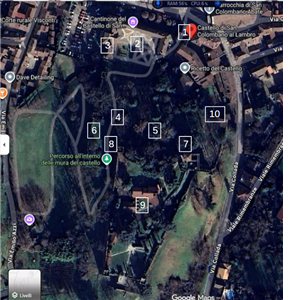 1. Entrance Tower (North tower) (Fig. 1): Represents the main entrance to the complex. The Visconti coat of arms and the recesses into which the beams for lifting the drawbridge were inserted are still visible. Next to the main bridge, intended for wagons, there was a small bridge for people. Originally there was a ravelin in the current square for further protection. 1. Entrance Tower (North tower) (Fig. 1): Represents the main entrance to the complex. The Visconti coat of arms and the recesses into which the beams for lifting the drawbridge were inserted are still visible. Next to the main bridge, intended for wagons, there was a small bridge for people. Originally there was a ravelin in the current square for further protection.
2. Court: The two-storey building that today dominates the courtyard dates back to the nineteenth century and was built by the Belgioioso family. The interior is largely in neo-Gothic style and can be visited.
3. West entrance tower: It has a similar structure to the north tower. The Visconti coat of arms was replaced here with that of the Carthusian order. Starting from the Carthusian period it also took on a residential function.
4. Park: What remains of the English park created by the Belgioioso family in the nineteenth century.
5. Well: One of the wells that served the ancient ricetto.
6. Western walls: They follow the hilly trend and have a sloping base and Ghibelline battlements. They are punctuated by square towers open towards the interior of the complex.
7. Tower Mirabello (or Petrarca): It is dedicated to the memory of Francesco Petrarca, who lived in the castle, guest of the Viscontis, in October 1353.
8. Torre Sporta (or Bona di Savoia): Thanks to its position, it strengthened the defense of the west side of the castle.
9. Rocca: Today privately owned. It is the part of the complex that for a long time had an exquisitely military function.
10. Eastern walls: They have a walkway supported by vaults which were subsequently incorporated into the buildings of the ricetto.
Below is the description of the main rooms of the west wing of the building which overlooks the courtyard, the part open to the public (Fig. 3).
Ground Floor
- Arms Gallery: Corresponds to the atrium of the princely residence of the Belgioioso family. It includes five spans decorated in neo-Gothic style. In it the Belgioioso family collected all the weapons present in the various towers of the castle. On the portal immediately to the left upon entering there is a terracotta bas-relief depicting the siege of the castle by Ludovico Belgioiso in 1529.
- Anteroom: Small room with wooden floor and ceiling. The walls are decorated with coats of arms and in the corners of the ceiling are depicted the coats of arms of the Belgioioso family and of the other families that have succeeded one another in ownership of the castle.
- Dining room: It was the dining room of the princes. Here too the floor and ceiling are made of wood. In addition, the lower half of the walls is covered with boiserie.
- Blue Room: It was the reception room. The ceiling is pavilion vaulted, with the ribs decorated in monochrome orange with fruit shoots, while in the areas between them, highlighted by blue bands, there are rich grotesque decorations. On the walls there are stylized blue grotesque decorations on a white background.
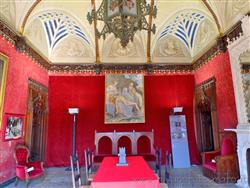
Red Room (Larger picture): It was the conversation room. It owes its name to the color of the damask upholstery. The vaulted pavilion ceiling is embellished with typically neo-Gothic decorations, with monochrome roundels depicting idealized characters in the lunettes.
The floor is Venetian.
On the east wall there is a torn fresco from the Oratory of Mary Magdalene depicting the Pietà on the Dead Christ. It was painted by Bernardino Campi around 1580.
On the south wall there is a fireplace covered in Carrara marble and a mirror with a marble frame surmounted by the family coat of arms.
From the center of the ceiling hangs a majestic chandelier in wood painted in bronze color and colored glass.
Green Room: It owes its name to the color that predominates on the walls. The painted vault presents the coats of arms and the arms of the Belgioioso family alternating with neo-Gothic panels and frames. The door and window openings are pointed arches.
First floor
Room with balcony: Small hallway which was originally part of a larger space. Like most of the rooms on the first floor, it was intended for guests.
Room with painted wooden ceiling: This is all that remains of the Carthusian oratory dedicated to Mary Magdalene. In particular it corresponds to the choir loft where the organ was present. The coffered ceiling is a fragment of the oratory ceiling and was created by Martino Bassi and painted by Bernardino Campi around 1580.
Second floor
Hall: It was originally divided by a corridor. The decoration is more approximate than in the other rooms.
Bedroom: It was the bedroom of the princes. The ceiling is embellished with colorful neo-Renaissance grotesque frescoes. There are two biforas built in the nineteenth century which recall the previous ones from the Visconti era.
The room is used as a Municipal Art Gallery dedicated to the artist Suzy Green Viterbo, an artist who was born in 1904 in Cairo, Egypt, died in 1999 and lived in San Colombano for thirty years.
Princess Bathroom: It was the bathroom. In the 1930s it was equipped with plumbing and heating systems that were cutting edge for the time. The floor is in colored concrete and the walls have fake marble decorations.
Categories: Places of historical value of landscape value
Via Principessa Maddalena Belgioioso, 77, 20078 San Colombano al Lambro MI |
Further pictures of Castle of San Colombano al Lambro in the section Photography |