View another treasure of Milan's art and history:
|
Sanctuary of Santa Maria Nascente in Lampugnano
|
|
|
Search by name:
|
 Mostly represented styles: Renaissance - Baroque Mostly represented styles: Renaissance - Baroque
The Sanctuary of Santa Maria Nascente in Lampugnano is one of the many churches in Milan which were originally located in villages completely independent of the Lombard capital and which deserve interest both for their history and for the works of art they contain.
HISTORY
Even if it is not clear from what the toponym Lampugnano derives, it is ascertained that the area already had settlements in the Celtic era. Lampugnano was a separate municipality from the second half of the thirteenth century to 1808, when, under Napoleon, it was suppressed.
Immediately after the fall of Napoleon, the Municipality of Lampugnano was briefly restored, but suppressed again in 1842 and definitively aggregated to the Municipality of Trenno, which in turn was then aggregated to Milan in 1923.
It is worth remembering that for at least the entire first half of the twentieth century, horse racing was very important in the Lampungnano district and many important stables were located there.
Very little remains of the ancient village today: the toponym, some nineteenth-century buildings and, indeed, the Sanctuary of Santa Maria Nascente. The latter was built at the beginning of the seventeenth century or even earlier, for the canons of the Milan Cathedral who had chosen Lampugnano as the site of their summer holidays. It is therefore no coincidence that the same dedication as the Cathedral was chosen.
On 31 October 1605 Card. Federico Borromeo made a pastoral visit to the church and the reports of this visit are the oldest documents in which its existence is attested.
STRUCTURE
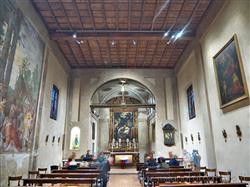
The church, facing east, has a simple rectangular plan with a large rectangular apse inserted at the back. At the back left, where the main body and the apse meet, is a square bell tower partially inserted into the church structure.
The facade is very simple and bordered on the sides by two pilasters. The only decorations are the frame around the single entrance door, raised four steps above street level, an oculus under the roof, and two pinnacles at either end.
The walls are punctuated by pilasters that match the division into spans inside.
On each side are two large rectangular windows.
The interior is also very simple and comprises a single nave divided into three spans. The internal side walls, like the exterior, are punctuated by pilasters that match the division into spans. The ceiling is wooden, coffered.
From the interior, the four stained-glass windows of the nave can be appreciated, depicting episodes from sacred texts. Although recent, they attempt to imitate the features of ancient windows.
On the counterfaçade, there is a wooden choir loft that extends from one side to the other.
To be noted also the baptismal font on the counterfaçade, immediately to the left of the entrance. It dates back to the sixteenth century and is made from a single block of pink marble.
The most striking work in the church is the large Renaissance Adoration of the Magi, which occupies almost the entire left wall of the second span and is attributed to the Luini school.
On the back wall, to the right of the entrance arch to the presbytery, hangs a rich Baroque retable in carved and gilded wood with architectural structure, which frames a sixteenth-century oil painting on panel depicting a Madonna with Goldfinch.
The triumphal arch leading into the presbytery features a curious, highly realistic intertwined flower decoration on the intrados.
Above the entrance to the presbytery is a carved and gilded wooden beam connecting the two sides of the arch. On the side facing the nave, it bears the inscription "Mors mea, vita tua" in gold letters.
At the center, the beam connects to the top of the presbytery entrance arch through a seventeenth-century wooden crucifix.
The presbytery features a sail vault decorated with four triangular panels. Each panel contains, at its center, a tondo depicting one of the Four Evangelists (Fig. 8).
Note the original terracotta floor and the fact that the entire lunette of the right wall is occupied by a large window.
The carved, painted, and gilded wooden altar dates back to the Baroque period. The retable is richly decorated with festoons, garlands, cherubs, and even lion heads. Its architectural structure features two lateral columns supporting an entablature, above which is a broken Baroque-style pediment. The retable frames the large altarpiece, which depicts the Birth of the Virgin and is attributed to Camillo Procaccini.
Noteworthy, in the altar, is also the tabernacle (Fig. 10), so meticulously decorated that its door features a depiction of Christ.
Finally, we would like to mention the curious Last Supper on the right wall of the presbytery, about which no information has been found, but which appears to date to the Baroque period (Fig. 7). It is interesting because it is completely different from the Renaissance paintings, which were modeled after Da Vinci's Last Supper. Even the clothes of the people present are entirely from the period in which the work was painted and there is no pretense of making their appearance resemble what the Apostles' real appearance might have been.
Update: Giorgio Uberti of the Associazione Borghi Milanesi has reported that the painting appears to be a copy of Francesco Bassano's Last Supper, housed in the Basilica of Santa Maria Maggiore in Bergamo.
If you are interested in a guided tour of this monument send an email!
Categories: Churches / Religious buildings
Via Carlo Osma, 9, 20151 Milano MI |
Further pictures of the Sanctuary of Santa Maria Nascente in Lampugnano in the section Photography |