|
Church of San Raffaele
|
|
|
Show an other treasure of art and history in Milan:
|
 Mostly represented styles: Renaissance Mostly represented styles: Renaissance
The Church of San Raffaele is a rather small church in the heart of the city, just steps from the Cathedral. It is completely nestled between adjacent houses, so only the façade is visible from the outside.
HISTORY
The Church of San Raffaele is a church of very ancient origins, having existed since at least 836, although as a chapel, when the Archbishop of Milan, Angiberto II, built (or rebuilt) six smaller churches arranged radially around the ancient Cathedral of Santa Maria Maggiore.
In 903, Archbishop Andrea da Canziano stipulated in his will that his house located between the Basilica of Santa Tecla and the monastery of Vigelinda (later Santa Redegonda), a chapel there dedicated to the angel Raphael, a bathhouse, and other spaces, be used as a hospital for the poors.
The church was solemnly consecrated in 1119 by Archbishop Giordano de Clivio.
San Raffaele was home to the Lay School of the Blessed Sacrament, which had grown in importance during the Counter-Reformation due to its efforts to combat the spread of Protestantism.
In 1569, under Saint Charles Borromeo, the church was transformed into a parish church and it was therefore decided to completely renovate it. For various reasons, however, including the severe plague epidemic of 1576, construction did not begin until 1579. It is unclear, however, when the work was completed, as some sources cite 1617 as the year of completion, while others still suggest that donations for the work were collected in 1633.
The design of the new church is attributed by most scholars to Pellegrino Pellegrini.
Of the previous church, only the general layout of three naves and an apse was preserved.
In 1787 the church ceased to be a parish and became a subsidiary of the Cathedral.
The upper order of the façade was completed only in 1892, designed by the then architect of the Fabbrica del Duomo, Paolo Cesa Bianchi, who was unaware of the original project and therefore created an imaginary design using partly recycled materials.
In 1902, there were plans to demolish the church to make way for the expansion of the adjacent Bocconi department store (now the Rinascente), but numerous protests blocked the project. The same attempt was then repeated in 1930 and 1948 (just a few years after the church had been repaired from damage caused by bombing during World War II), but in both cases, fortunately, it was ultimately not carried out.
The interiors were restored a few years ago, with new marble flooring.
STRUCTURE
From the outside of the church, only the two-story facade is visible. The lower one is an original 16th-century structure. It is divided into three sections that reflect the internal division into naves. Each section is delimited by fluted pilasters that taper downwards, decorated in the center with a lion's head and surmounted by imposing, prominent bearded herms.
Each section includes an entrance. The main central entrance is larger than the side ones and features a stone portal with two corbel-shaped volutes above, connected by volutes and a decorative band, supporting a curved pediment. The interior of the pediment is further enriched with additional volutes and decorative elements in relief with a plant theme.
The two side doors also feature a portal. The upper section features a panel with a cherub's head, volutes, and a decorative band. Above it is a lunette window.
The herms support the entablature, which also includes a rather protruding cornice.
The upper order covers only the central section. This is bordered on the sides by two pairs of smooth columns with Corinthian capitals. Between them is a large rectangular window set between two pilasters slightly set back from the columns, also with Corinthian capitals. The large window is bordered on the sides by two smooth columns with capitals supporting a triangular pediment. The window is embellished with a cherub's head below it and a lion's head above it.
The façade ends at the top with a large triangular pediment divided into multiple levels, with the central section set further back than the lateral sections. Inside the pediment is the inscription "St. Raphael."
At the sides, the upper order is connected to the lower one by two volutes.
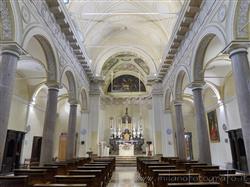
The interior has three naves, separated by arches resting on round stone columns. The central nave features a barrel vault with lunettes, while the side naves are divided into spans with ribbed vaults.
In the first two spans of the central nave, the vault is decorated with two ovals depicting various scenes (angels and cherubs in two, and the other two are unclear). In the other spans, these ovals are empty because the originals were lost during bombing during World War II.
Above the arches delimiting the central nave runs a band with stucco decorations depicting symbols of the church and the Passion. Above this runs a very protruding cornice resting on corbels, separating the walls from the ceiling and running along the entire central nave, including the counterfaçade, and also in the apse.
The counterfaçade is occupied by the wooden porches of the three entrance doors. The central one is much larger than the side ones, and above it is a choir loft containing an organ. A second organ, more recent but beautifully crafted, is located at the head of the left side nave.
Page under construction!
If you are interested in a guided tour of this monument send an email!
Categories: Churches / Religious buildings
Via S. Raffaele, 3, 20121 Milano MI |
Further pictures of the Church of San Raffaele in the section Photography |