View another treasure of Milan's art and history:
|
Basilica of San Marco
|
|
|
Search by name:
|
 Mostly represented styles: Gothic - Renaissance - Baroque Mostly represented styles: Gothic - Renaissance - Baroque
St. Mark's Basilica is another rarely visited Milanese monument, despite its great historical importance and rich artistic heritage. Since the demolition of the Church of San Francesco Grande, with a length of 109 meters, it has become the second largest church in Milan after the Cathedral.
HISTORY
The architectural origins of the church are shrouded in uncertainty. According to tradition, the first stone was laid in 1254 by Lanfranco Settala, first general prior of the Augustinian Order. However, there is evidence that suggests the church was founded before that date.
A Venetian codex states that construction of the church began in 1167 and that the building's name was intended as a tribute to Venice, which aided the city of Milan during the struggle against Frederick Barbarossa. However, it is unlikely that this actually occurred.
It should be noted that when the church was built, it was located outside the city walls. This, however, is not surprising, as having churches outside the walls had been a typical feature of Milan since the time of Ambrose.
In fact, it is thought that the first version of the church dates back to a period before 1254 and corresponds to the presence on site of the Zambonins, penitent followers of the Augustinian rule, which included Lanfranco Settala himself, and who joined the Augustinian Order in 1256.
This first version of the church is thought to have had a structure similar to the late Romanesque one that Basilica of San Simpliciano had at the time, that is, it was a hall church with all the naves of more or less equal height, and with the two arms of the transept comprising two naves, also of equal height. According to some, this first phase could have lasted from the end of the twelfth century to 1254, while others believe it may have begun as early as the thirteenth century.
The second phase, initiated by Settala, brought such a significant change of direction that its beginning (1254) is considered the date of its foundation. Following the Cistercian canons, a large rectangular choir was created (corresponding to the first span of the current presbytery), six chapels were added on the eastern sides of the two arms of the transept with pointed cross vaults, and the windows were moved.
In the first half of the fourteenth century, it was decided to make the church a three-apse church. This was achieved by transforming the two transept chapels bordering the central apse into lateral apses. The cross vaults of the two transept arms also correspond to this phase.
At the beginning of the fourteenth century, the bell tower was built, over what was then the Chapel of St. Mary or the left lateral apse, depending on the actual sequence of the modifications. At this time, the chapel was divided in two by a partition to support the weight of the bell tower. The front part of this chapel is now the Chapel of San Carlo.
The first chapel on the south side of the main body of the church, the Cusani Chapel, is documented from 1345.
Around 1350 the church must have had a basilica layout comprising three naves, each with at least five spans, two chapels on the south side (corresponding to the sixth and seventh chapels of those present today), three apses, and two additional chapels on the east side of each transept arm. The walls of the central nave featured tall Gothic single-lancet windows. The complex also included a sacristy, two cloisters (the sources disagree here, as some say the second cloister was built in the fifteenth century), guesthouses and dormitories for the friars, a scriptorium, and various armories where the codices owned by the monastery were kept.
In the second half of the fourteenth century, the Church of San Marco benefited from significant donations from the Visconti family and other prominent Milanese families. This made it possible to lengthen the nave by five spans and build the façade (which, however, was never completed), the design of which is attributed to a certain Menclozzo. The new spans, at least those of the central nave, were not vaulted, but rather trussed. Furthermore, the new spans were built slightly longer than the existing ones. The interior of the church thus took on an overall ungainly appearance, with ten spans delimited by round pillars, five of which in the central nave were vaulted and five with exposed trusses.
During the fifteenth century, the second cloister was built, which was unfortunately demolished under Fascism to make way for the new Parini High School.
Also in the fifteenth century, the presbytery was expanded with the addition of a second span and the creation of a new polygonal apse, later modernized in the seventeenth century.
The side chapels of the right nave were also standardized, consisting of a square room and a polygonal apse (most of the chapels subsequently lost this structure).
Many of the modifications made to the church during the fifteenth century are attributed to the brothers Pietro and Giovanni Solari, who left a significant mark on Milanese architecture of the period.
In the sixteenth century, the convent of San Marco underwent a period of crisis, which was overcome only with the transition to the second half of the century. Between 1555 and 1557, the first cloister was rebuilt. The Gothic single-lancet windows in the walls of the central nave were replaced by tall, low-arched openings.
The octagonal domes that replaced the original Solarian roofs in the square spaces of the first five chapels also date back to this century. The first chapel to be modernized (and brought to its current form) was the Foppa Chapel, completed in 1520, the first one starting from the entrance.
It should be noted that in the sixteenth century, the left side of the church contained only altars with their associated painted wall decorations, not proper chapels.
The seventeenth century was a century of important changes for the Church of San Marco.
In 1618, the dedication of the third chapel in the right transept was changed from Saint Stephen to the new Augustinian saint Thomas of Villanova. In the same year, the fresco decoration of the vault was redone by the Fiamminghini Brothers.
In the first half of the seventeenth century, the pictorial decoration of the presbytery and choir was completely redone, with Bartolomeo Roverio, known as Genovesino, and the Fiamminghini Brothers responsible for the frescoes, and Camillo Procaccini, Giovanni Battista Crespi, known as Cerano, and Genovesino again responsible for the large paintings on the walls.
During this period, the Fiamminghini Brothers also had the first cloister frescoed. Unfortunately very little of these frescoes, still quite visible in 1935, remain today.
During the same period, the large Chapel of the Crucifix, now known as the Chapel of the Pietà, was also built by merging the two outermost chapels of the northern transept. It later became for a long time home to the important Confraternity of the Crucifix.
The carved solid wood choir stalls in the apse were installed between 1620 and 1630.
In 1635, construction began on the new, large, monumental sacristy, the current one, which was completed around 1645.
The period between the seventeenth and eighteenth centuries, between 1690 and 1714, saw the implementation of many important changes to the general structure of the church, which gave it its current appearance. The interior was radically modernized in Baroque style. The circular Gothic pillars were enlarged to form cruciform pillars. All the spans were covered with vaults. Furthermore, the two pillars closest to the presbytery were demolished to create a large dome above the two joined spans. These changes were designed by architects Castelli and Quarantini and carried out by master builders Fontana and Ratto.
The modifications were completed by widening the sixteenth-century windows, replacing the rose window on the façade with a lower rectangular window (because the original rose window was now above the vaults and therefore no longer able to illuminate the interior of the church), adding a cornice along the entire interior perimeter and creating the rich stucco decorations.
The entrance arches to the side chapels were also symmetrical, dividing them into bays, and for the same reason, squares were painted on the left wall around the various altars.
In 1787, the Church of San Marco became a parish church, but the structure of the convent remained intact.
With the arrival of Napoleon's French forces in 1796, the monastery was suppressed, and the Augustinians abandoned the church. The convent was transformed first into barracks, then into a military hospital. The church, however, was even used as a stable.
The last major renovation of the church dates back to the second half of the nineteenth century, when architect Carlo Maciachini, in keeping with the fashions of the time, wanted to restore the façade to the original late medieval style in which Menclozzo had conceived it, also because the façade appeared rather ungainly and untidy. Maciachini thus created a neo-Gothic façade (completed in 1873), approximately four meters taller than the previous one and pleasing to the eye, although a bit overdone. The large central rose window and the mullioned windows alongside it were restored, and triple lancet windows were created above the two side entrances. Above, the façade was given a triple cornice with intertwined flame arches underneath, inspired by the original medieval ones above the central portal.
In 1885, thanks to Giuseppe Mongeri, the bell tower, which had remained unfinished since its construction, was finally completed. It was lengthened by adding a tall Neo-Gothic cornice similar to those added to the façade by Maciachini and a conical spire imitating those typical of Lombard Gothic architecture.
It is worth noting that the structures corresponding to the convent of San Marco were long used to provide assistance to the poor and needy. In 1784, the Austrian government transformed parts of the convent into the Casa del Lavoro Volontario (House of Volunteer Labor), which later became the Casa d'Industria (House of Industry) from 1808 to 1815, and later the Pia Casa San Marco (Pious House of San Marco) until 1930, when the second cloister and half of the first were demolished to build the Parini High School. From 1839, the former Convent of San Marco was also the temporary headquarters of the Institute of the Blinds of Milan.
STRUCTURE
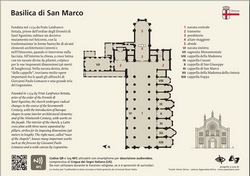
The Basilica of San Marco has a complex structure, the result of its history, and is part of an even more riculated complex that includes what remains of what was once the Convent of San Marco.
The church itself has a main body divided into three naves, a transept with very broad, projecting arms, and a very long choir ending in a polygonal apse. The south side features numerous chapels of varying sizes and shapes.
Above the intersection between the main body and the transept, protecting the Baroque dome, there is outsice a circular tiburium with a lantern.
Much of the basilica is made of exposed brick. The exceptions are the chapels on the south side, whose walls are plastered.
The bell tower is located at the rear of the north arm of the transept, on the side adjacent to the choir. It has a square plan and is divided into sections decorated at the top by cornices of hanging arches. The bell chamber has a large mullioned window on each side. As previously explained, the bell tower was extensively remodeled in the nineteenth century, and the tall spire is recent.
The choir and the southern transept are characterized by high external buttresses (the northern transept, however, is incorporated into other structures).
The façade of the southern transept features two groups of windows. At the top, a central bifor flanked by two single-lancet windows. Below, in the western half, are two single-lancet windows and an oculus above them. Note that the upper windows are located above the internal vaults and therefore do not illuminate the interior. This demonstrates that they were created before the vaults, after which the lower windows were added.
The left side of the church is flat and is visible only from inside what remains of the first cloister. The facade of the northern arm of the transept was instead erased by the construction of the monumental sacristy, which doubles the length of the transept arm, and of other service buildings.
The basilica's current façade is a blend of original Gothic elements and Neo-Gothic elements resulting from Maciachini's restoration. Vertically, it is punctuated by four pilasters, whose position reflects the internal division into naves. Horizontally, the façade is divided into two orders, emphasized by the presence of natural stone on the lower order. The upper order, however, is made entirely of brick. This division was already present originally.
The portal is a Gothic arch, although very shallow. Of great value is the stone architrave, attributed to Bonino da Campione and therefore dating back to the fourteenth century, which features seven panels depicting Christ the Judge (in the center), Saint Augustine (on the far left), Saint Ambrose, and the Four Evangelists in the remaining panels. The mosaic in the lunette, depicting the Madonna and Child between Saint Augustine and Saint Mark, is recent, having been created in 1965.
Above the side entrances are two large, richly decorated terracotta triforas within rectangular panels.
The upper order is characterized by the large rose window in the center and the two biforas placed below it on the sides. These were also present already originally. The lower edge of the upper order, in the central section, features a band of original Gothic overlapping arches.
Immediately below the rose window is a terracotta panel with three niches containing three statues depicting Saint Augustine, Saint Mark, and Saint Ambrose. They date back to at least the fourteenth century or may be older than the façade itself, ie come from another structure in the city.
The two oculi within the square terracotta panels in the two lateral sections of the upper order are original, except for the central decoration.
At the top, the façade terminates with a triple cornice, the fruit of Maciachini's creativity, the lower of which features intertwined flame-shaped arches. At the apex of each pilaster strip and at the top, he placed a small aedicule containing the statue of the Madonna (the one at the top) and of saints. However, the two lateral ones were lost during the war.
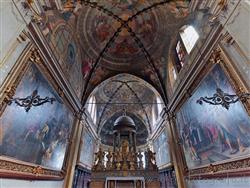
The interior of the basilica is a Latin cross plan with three naves separated by large cruciform pillars connected by round arches. The vaults of the spans are barrel vaults with lunettes in the central nave, and cross vaults in the side naves.
Towards the central nave, the pillars feature pilasters with partially gilded stucco capitals of the composite Ionic-Corinthian order. Between the capitals and the vaults, along the entire length of the central nave and also in the presbytery, choir, and counterfaçade, two cornices separated by an empty band extend. The upper cornice is significantly protruding and supported by a corbel of partially gilded acanthus leaves.
The lunettes of the central nave vault are occupied by large Baroque windows, which, however, being so high up, do not allow the church to be particularly bright. It should be noted that the large rose window on the counterfaçade is located above the vaults and therefore does not contribute to the illumination.
In the central section, the counterfaçade is occupied at the bottom by a large Baroque carved solid wood wind break. Above, there is a large empty richly decorated stucco cornice flanked by two lions.
The space in front of the presbytery, corresponding to what were originally two spans of the central nave, is occupied by the large, slightly oval Baroque dome (with its long axis running longitudinally). It has no tambour; there is only a cornice at the base, similar in structure to the one running along the central nave. The dome is divided into eight segments delimited by double flat ribs. At the base of each segment is a window, with four real windows and four simulated ones alternating.
The top of the dome is occupied by a lantern with large windows.
The dome's pendentives are filled with large plaster high reliefs depicting the four evangelists.
Note, on the sides of the dome, four simulated windows complete with festoon decorations like the windows of the nave.
All the structures of the nave are embellished with partially gilded Baroque stucco decorations:
- The keystones of the spans are oak-leaf-shaped. The four bases of each vault are decorated with acanthus leaves.
- The large windows in the lunettes are surrounded by a sumptuous mixtilinear frame with a small canopy above. Beneath this is an enlarged shell from which festoons branch out, encircling the window.
- The large frame on the counterfaçade echoes the structure of the windows, but here the shell is replaced by the Augustinian coat of arms (recognizable by the pierced heart above the book).
- The arches of the central nave are underlined by golden frames with a small frame at the top with festoons and acanthus leaves.
- The double ribs of the dome contain a garland and are connected by garlands. A garland also surrounds the opening of the lantern.
- The windows of the dome are surrounded by an elaborate frame characterized at the top by a swallowtail motif with alternatively a shell or a scroll in the centre.
The last left arch of the central nave houses a neoclassical choir loft containing the organ. It is uncertain when the choir loft was built. According to tradition between 1711 and 1714, but stylistic considerations suggest that it was built in the early nineteenth century, perhaps during the organ renovation by Eugenio Biroldi, completed in 1819. The gilded panels of the balustrade illustrate episodes from the Old Testament.
What was said about the choir loft also applies to the pulpit, located on the third left pillar starting from the presbytery. The carved wooden telamons that support it are probably an exception. They are thought to be recycled material dating back to a period between the late seventeenth and early eighteenth centuries.
The two arms of the transept are covered by a cross vault with semicircular ribs. The sails of the vault of the southern arm still show traces of decorative frescoes. In the northern arm, however, the ribs still retain their Cosmatesque motif decorations.
Apart from this, the two arms are very different today. The southern arm includes the oldest elements in the church, particularly parts of sarcophagi and medieval funerary monuments that were demolished and partly dispersed under San Carlo and then under Joseph II of Austria.
At the end of the transept is the Ark of Lanfranco Settala, a man of the same name as the founder of the convent and close to Giovanni Visconti. The monument, attributed to Giovanni di Balduccio, retains part of the original polychrome. Lanfranco Settala is depicted in a chair, before a crowd of listeners, both lay and cleric. He is then depicted a second time above, on his deathbed, watched over by two deacons. Two side niches depict Saint Agnes and Saint Catherine of Alexandria.
In the lower section of the western wall of the right transept are three sarcophagi, also from the fourteenth century.
- Sarcophagus of the Three Kings: It features a single large panel depicting three scenes: on the left, the Madonna and Child with the eldest of the Three Kings kneeling before her; in the center, the other two Kings; and on the right, the two clients accompanied by Saint Lawrence, an apostle saint, and Saint Francis (or an Augustinian). There are also two side niches: in the left niche, Saint John the Baptist (or perhaps Isaiah) with a scroll; and in the right niche, an evangelist, Matthew or Mark.
- Sarcophagus of Martino Aliprandi: The front panel is divided into three compartments and two side niches. The left section depicts the Presentation of the deceased and three other figures to the Virgin, in the presence of the patron saints. The central section depicts the Trinity in the form of the Throne of Grace. Unfortunately, the dove was lost in the last century. In the right section, eight disciples listen to the Master at the cathedra.
In the side niches, Saint Augustine can be seen on the left and Saint Mark on the right.
Above the sarcophagus are two statues of deacons.
- Sarcophagus of Gabriele Bossi: The front features three panels. The central panel depicts the client being presented by Saint Ambrose and Saint John the Baptist to the Virgin and Child. The two side panels feature two noble emblems in the form of busts.
The wall is entirely covered with frescoes, in the lower part dating back to the fourteenth century, in the upper part to the seventeenth century (Fig. 8).
In the lower section, from left to right:
- A saint, no longer recognizable today
- A Giotto-style Crucifixion. In it, the crucified Christ is flanked by two angels collecting his blood in chalices. To the left of the crucifix is ??the Madonna, supported by a pious woman; to the right are Saint John the Evangelist, Saint Anthony the Abbot, and Saint Augustine holding a scroll.
- An Assumption of the Virgin, rediscovered only in 1956. In it, the Virgin rises alone, ccording to an iconographic model common in France but very rare in Italy. The heads of five apostles are still visible at the bottom. Only the lower part of the Virgin's robe is visible, pure white, surrounded by angels bearing scrolls.
- The lower part of a Saint Christopher, recognizable by the depiction of the river, complete with fish and starfish.
The artists of these frescoes are unknown.
In the upper part, what remains of a large fresco created in the first decade of the seventeenth century by the brothers Giovanni Mauro and Giovanni Battista della Rovere, known as Fiamminghini, is visible. It depicts Pope Alexander IV giving the papal bull of union to the abbot of the Augustinians, Lanfranco Settala. The event, which took place in 1256, is depicted in a complex manner:
On the left, under a pavilion, the pontiff hands the papal bull to Lanfranco Settala; on the right, a woman helps a poor man; in the background, the Augustinians preach and discuss; from heaven, Saint Augustine, surrounded by angels, blesses the scene.
The eastern wall houses the Chapel of San Tommaso di Villanova, the passage towards the secondary rear door, created from what was once the Aliprandi Chapel, and the Chapel of Saint Augustine.
The Chapel of Saint Thomas of Villanova is the result of a change of dedication that occurred in the first half of the seventeenth century. The vault was frescoed by the Flemish painters with trompe l'oeil arches containing, alternating, the Evangelists and the Fathers of the Latin Church. They are arranged around a central oval depicting the Eternal Father. The chapel also contains many ancient elements:
- In the Gothic entrance archway are the remains of a fourteenth-century fresco depicting, in the center, Christ the Judge flanked by Saints Peter and Paul and two other apostles.
- Sarcophagus of Salvarino Aliprandi: Salvarino Aliprandi was a jurist at the College of Milan and died in 1344. The front of his sarcophagus, attributed to the Master of Viboldone, is embedded in the left wall. On the left, the deceased is depicted, led by the Madonna and accompanied by a saint and his guardian angel, presented to Christ the Judge enthroned in the center. On the right, Saint John the Baptist points to the tree of life.
- Front of the Coronation: Front of another 14th-century sarcophagus, embedded opposite that of Salvarino Aliprandi and centered on the Virgin. It comprises three panels. In the left panel, the Madonna is depicted as the mother of the infant Jesus. The patron saints present the clients to her against a backdrop of angels holding a drape. The central panel depicts the Coronation of the Virgin by Christ, with nine angels arranged around them. Finally, the right panel features a Lamentation of the Dead Christ.
- Sarcophagus of Andrea Birago: It is embedded in the back wall and dates back to 1455. On the front, the deceased is depicted accompanied by Saint Andrew in the act of offering his noble crown to the Virgin and Child. The side niches contain St. John the Baptist and St. Victor.
The passage to the rear entrance was originally the Chapel of Saint Ursula, also the chapel of the Aliprandi family. Evidence of this is a votive fresco on the left wall depicting the Virgin Enthroned with Child, Saint Augustine, and the Aliprandi family. The funerary plaque of Alessandro and Lancillotto Pusterla, mounted opposite it on the right wall, dates back to the 16th century.
The decorations on the vault and lunettes, likely from 1618, are attributed to Domenico Pellegrini. The vault is decorated with geometric-floral motifs and cherub heads. The lunette on the right depicts the Martyrdom of Saint Ursula, while the one on the left depicts the Glory of Saint Ursula. In both cases, the figures are placed within monochrome trompe l'oeil frames.
Note, walled between the two chapels, is the tombstone of Cristoforo Caimo, a jurist and scholar who died in 1539.
Chapel of Saint Augustine: This is the third chapel, adjacent to the presbytery. It originally housed an altarpiece by Enea Salmeggia depicting the saint. The current one, from 1712, was painted by Paolo Pagani and depicts Saint Liborio healing stone sufferers. On the left wall is a canvas by Federico Bianchi, known as Crespino, from the late seventeenth century, depicting Saint Lucy. On the right wall, one by Pietro Maggi from the early eighteenth century, depicting the Vision of Saint Monica. The vault of the chapel is barrel-shaped and is decorated with frames that divide it into compartments.
The appearance of the left arm of the transept is defined by Baroque-era modifications.
The lower part of the back wall is occupied by the entrance to the monumental sacristy. The double-leaf solid wooden door is surrounded by a sumptuous red marble portal decorated with lion and cherub heads and a large triangular pediment above which are two cherubs (on the sides) and
the bust of a bishop holding a model of a church (no information on this has been found).
Above is a large fresco by Federico Bianchi from the early eighteenth century depicting the Expulsion of Heliodorus from the Temple.
The left wall, which features a large crescent-shaped window at the top, is occupied by two large canvases by Stefano Maria Legnani, known as Legnanino, likely from the early eighteenth century, depicting Saint Augustine Washing the Feet of Christ in the Form of a Pilgrim and The Apparition to Saint Augustine of the Relic of the Holy Band.
Chapel of the Crucifix or of the Pietà (Fig. 9): This occupies the entire part of the eastern wall extending beyond the width of the central body of the church, and is almost entirely covered in Baroque stucco and frescoes, all from the mid-seventeenth century. The wooden processional cross that once stood on the altar and which gave the chapel its name was unfortunately destroyed during the Cisalpine Republic.
The intrados of the entrance arch is decorated with five frescoes by Ercole Procaccini the Younger, surrounded by opulent stucco frames and depicting Stories of the Passion: The Crowning with Thorns, Ecce Homo, Agony in the Garden, the Kiss of Judas, and the Flagellation. The side walls are occupied by two large canvases within sumptuous gilded stucco frames: on the left, The Way to Calvary with the Meeting of the Pious Women and the Episode of Veronica, by Ercole Procaccini the Younger; on the right, The Raising of the Cross, by Antonio Busca.
The altar is flanked by frescoes depicting rich green curtains parted by flying putti. The altar is made of red and black polychrome marble. The retable is closed at the top by two pediments nested one inside the other and is decorated with volutes, fruit compositions, and cherub heads. The altarpiece is a copy of Caravaggio's Deposition (the original is in the Brera). The apse of the chapel is flanked by partially gilded fluted pilasters with Corinthian capitals, and features on the side walls a Madonna Addolorata (left) and a Saint John the Evangelist (right). Resting above the entrance arch of the apse are depictions of David (left) and the prophet Isaiah. On the vault, again within stucco frames, are (from left to right) the Sacrifice of Isaac, Eternal Father, and the Sacrifice of Moses.
The chapel's walls are separated from the vault by a cornice and, immediately below, by a band attributed to Giovanni Stefano Doneda, known as Montalto, depicting the Emblems of the Passion held by angels, with Veronica at the center.
The vault of the chapel includes three lunettes. They depict the Way to the Tomb of the Pious Women (left), the Astonishment of the Soldiers at the Empty Tomb (center), and the Way to the Tomb of Peter and John (right), with the first and third attributed to Luigi Pellegrino Scaramuccia, the second to the Montalto. Finally, the dome is occupied by a Resurrection attributed to Scaramuccia.
Chapel of San Carlo: It is located between the Chapel of the Pietà and the presbytery. The vault is barrel-vaulted, with trompe l'oeil decoration simulating a coffered surface. The altar is neoclassical. The saint is depicted on the altarpiece and on the two canvases on the walls.
Side Chapels
These are located only on the right side of the church. Starting from the entrance, we find:
Foppa Chapel (Fig. 3, 4): The chapel of the Foppa family, it is dedicated to Saints Peter and Paul. It was commissioned by Pietro Foppa in 1529 and entirely frescoed in 1570 by Gianpaolo Lomazzo. It is closed by a wrought iron gate and consists of a square body with an octagonal dome and a polygonal apse. The entrance arch is still Gothic, with Renaissance stucco decorations in the intrados (the same is true for the entrance arch to the apse). All the structural lines in the chapel are highlighted by stucco decorations depicting ropes and thin bands.
The left wall is occupied by a large fresco depicting The Fall of Simon Magus. The fresco on the right wall depicts Saint Paul Bringing a Dead Man Back to Life, but has been largely lost. The dome's pendentives feature the Four Evangelists, while the dome's segments feature the Prophets of the Old Testament.
In the apse, the walls are decorated with gilded stucco frames and panels. The altar has a scagliola front. The altarpiece consists of a large carved and gilded wooden frame enclosing the altarpiece, also by Lomazzo, depicting the Coronation of the Virgin and Child with Saints Peter, Augustine, and Paul.
The apse basin is entirely occupied by a colorful and stunning Angelic Glory.
Chapel of the Virgin of the Belt (Fig. 7): It is the result of a late Baroque renovation of the previous chapel. The current chapel was likely completed in 1727. It was designed by Giuseppe Quadrio and built by his nephew Antonio. It is bordered by a sumptuous wrought-iron gate.
The polygonal apse was replaced by a cylindrical body serving as a presbytery, featuring eleven windows (some blind) on multiple levels. This presbytery area is separated from the body of the chapel by a polychrome marble balustrade. Its surfaces are enlivened by partially gilded stucco decorations in the form of cherubs, clouds, fanciful frames, and garlands.
The decorations of the main body date back about fifteen years later. On each side are two paintings by Francesco Fusi and Girolamo Givone in sumptuous stucco frames. On the vault, golden rays emanate from a stucco cloud with the dove of the Holy Spirit at the center.
The sumptuous altar is made of polychrome red, green, and black marble, with metal inserts. It features a retable made concave by the fact that the two cruciform and fluted pillars on the sides are positioned further forward than the large central niche containing the statue of the Madonna of the Belt of lacquered wood, attributed to Giuseppe Puricelli. This is characterized by a dynamic pose, both of the Madonna, who appears almost unsteady, and of the Child, whose head is bowed toward the sphere symbolizing the world he holds in his hand, in a direction diverging from that of Mary.
Also noteworthy are the two black marble cherubs with golden wings sitting laterally above the altar and holding scrolls.
Chapel of St. Mark (Fig. 5): It still features the structure with a square main body covered by an octagonal dome and a polygonal apse. The upper part of the altar consists of a large frame with gilded decorations containing an altarpiece depicting St. Mark.
The left wall of the central body is entirely occupied by a very large canvas depicting the Burial and Glory of Saint Petronilla, a work by the 17th-century painter Ercole Gennari.
On the right wall, however, is an equally large canvas depicting the Presentation of the Blessed Virgin Mary in the Temple, an 18th-century work by Giovanni Conca.
Chapel of St. Joseph: This chapel also retains its original 16th-century structure, to which Baroque decoration were added.
The central body is covered by a dome whose cap is entirely occupied by a 16th-century fresco by Carlo Urbino depicting the Pentecost, a bold perspective from below in which the figures freely compose themselves against the sky-blue background of the cap. The dynamic effect is emphasized by the rich gilded stucco at the base of the dome, characterized by a wavy motif in contrast to the oculi at the base of the dome.
The pendentives feature sumptuous trapezoidal frames with the allegories of the four cardinal virtues.
On the walls are two 17th-century canvases in rich gilded mixtilinear frames. On the left, Tribute to Caesar by Antonio Busca; on the right, Samuel anointing David by Santagostino Agostino.
The polychrome marble altar has an architecturally structured altarpiece, with two twisted columns supporting a broken pediment. The altarpiece depicts Saint Joseph. The pale blue apse basin, with segments highlighted by gilded stucco decorations with a plant theme, is topped by a cloud populated by cherubs and cherub heads, from which countless golden rays emanate.
Cusani Chapel: It too retains its Renaissance structure, although unfortunately the frescoes on the side walls have been lost. The most important part is the dome, decorated by the Genoese painter Ottavio Semino. It is separated from the walls by a finely decorated band and a cornice above it. The pendentives depict the four evangelists.
The eight sides of the tambour are separated by fluted pilasters, and each has a window with an exquisite Renaissance frame. Around them are frescoes, now barely legible, depicting angels and candelabra. The segments of the dome, separated from the tambour by another frame, are eight segments delimited by triple bands, with the central one decorated with grotesques. Note that these bands extend into the lantern. The segments contain ovals containing the personifications of the Virtues.
The chapel is today dedicated to the Crucifix. The one present in the altar is from the sixteenth century. The two large canvases on the side walls were painted in 1937 by Massimiliano Gallelli and depict The Deposition of Jesus from the Cross (on the left) and The Adoration of the Cross (on the right).
Chapel of Our Lady of Good Counsel: It is notable for the presence, on the side walls, of two paintings by the late Baroque painter Federico Ferrario depicting two Miracles of Our Lady of Good Counsel.
Chapel of Saint Nicholas of Tolentino: This chapel has a late Baroque appearance, like that of the Madonna of the Belt, but with fewer stuccoes and more colors. The pictorial decorations are the work of Giovanni Ens. On the side walls are two ovals with the Birth and Death of Saint Nicholas. The lunettes on the walls depict Saint Nicholas Assisting the Plague Victims and the Miracle of the Crucifix. In the pendentives of the dome are four Angels. The Fathers of the Latin Church are depicted in the dome's tambour, while the dome's cap is occupied by a quadratura depicting a circular colonnade open to the sky.
All the interior surfaces of the presbytery are colored, either by frescoes or by polychrome marble. The two windows feature gilded stucco frames whose shapes recall those of the windows in the nave.
The polychrome marble altar appears more imposing due to the trompe l'oeil decorations on the wall that appear as lateral extensions of the altarpiece.
Eighth chapel on the right: It houses a late Baroque nativity scene composed of oil paintings on papier-mâché glued onto wooden supports. The work is attributed to Francesco Londonio, a Milanese painter born in 1723, who imported the technique of silhouette-based nativity scenes to Milan after his travels in southern Italy, where the technique was widespread. It is believed he created the nativity scene around the mid-eighteenth century.
Ninth chapel on the right: It is no longer visible because it was converted into a weekday sacristy. On the cross vault, three vaults are completely filled (the section on the fourth vault has unfortunately been almost completely lost) with baroque depictions of the Fathers of the Latin Church. On the right wall is a detached fresco depicting the Miracle of the Three Children.
On the left side, there are no actual chapels, but only quadraturas painted on the wall inside the arches. However, their quality is so high that even up close it is often unclear whether they are painted or three-dimensional. Starting from the counterfaçade, we have:
First left arch: Former baptistery. The quadratura is attributed to Giovanni Battista Riccardi. The painting depicting the Baptism of Christ is by an unknown artist.
Second left arch: The quadratura is attributed to Giuseppe Mariani. A portion of it was removed to reveal an Adoration of the Magi from the circle of Carlo Urbino.
Third left arch: The quadratura is attributed to Francesco Porro. Part of it was removed to reveal a monochrome Virgin and Child from the school of Leonardo, perhaps by Bernardino Luini, rediscovered in 1975.
Fourth left arch: The quadratura is attributed to Gianbattista and Gerolamo Grandi. On the wall is a Transfiguration of Jesus by Giulio Cesare Procaccini.
Fifth left arch (Fig. 10): The quadratura is attributed to Gianbattista and Gerolamo Grandi. The fresco in the center depicting the Baptism of Christ is attributed to Aurelio or Bernardino Luini.
Sixth left arch: The quadratura is attributed to Francesco Porro. Hanging on the wall is a canvas by the late Renaissance painter Jacopo Palma the Younger depicting Madonna and Child in Glory with Saint John the Baptist, Saint Charles, and Saint Francis of Assisi.
Seventh left arch: The quadratura is attributed to Gianbattista and Gerolamo Grandi. Hanging on the wall is a canvas by Camillo Procaccini depicting the Madonna and Child with Saints Peter and Paul.
Eighth left arch: The quadratura is attributed to Gianbattista and Gerolamo Grandi. Hanging on the wall is a canvas by Luigi Pellegrino Scaramuccia depicting Saint Barbara.
Also worthy of mention are the niche in the left nave, almost at the corner with the transept, dedicated to the Holy Child Mary, and, on the other side, a small late Baroque altar in polychrome marble dedicated to Saint Anthony of Padua and rich in sumptuous decorations.
The presbytery and choir (larger picture) are as wide as the central nave and form a natural continuation of it. They comprise two square spans and a polygonal apse. One difference, however, is the cornice between the walls and vaults, which is slightly lower than the one running along the nave and is slightly simplified. The walls are vertically punctuated by fluted and gilded pilasters, in the choir placed at the corners and therefore folded like a book. Each capital features a cherub's head.
The triumphal arch of the presbytery is richly decorated with stucco depicting cherubs among clouds pulling aside a large curtain. At the center of the arch, crossed by a beam to which a crucifix is ??fixed, two cherubs hold an open book with a reference to Saint Mark written in gold letters.
The presbytery and choir are illuminated by large Diocletian windows in three of the lunettes on the side walls and by four large rectangular windows in the apse.
Almost all surfaces are covered with frescoes (painted by Bartolomeo Raverio, known as Genovesimo, and by Giovanni Battista and Giovanni Mauro Della Rovere, known as the Fiamminghini), pictorial decorations, or, in the case of the secondary sections, grotesques or floral decorations.
First span: The side walls are occupied by two majestic canvases in finely carved gilded frames, painted in 1618. On the left is Confession and Baptism of Augustine, by Giovanni Battista Crespi, known as Cerano. On the right is Disputation between Ambrose and Augustine and Conversion of Augustine, by Camillo Procaccini.
In the right lunette, next to the window, the prophets Micah and Ezekiel are depicted. In the left lunette, the window is only painted, as a clock stands in its place. Here, the prophets to the sides are Daniel and Baruch.
The vault is dedicated to the Evangelists. They are depicted in the center of a domed quadratura that occupies the entire vault. Eight figures of Angels appear in succession in the corners.
Second span: It has an identical structure to the first. The two large paintings on the walls, also from 1618, are the work of Bartolomeo Roverio known as il Genovesino. They depict, on the left, the Representatives of the religious orders of the Augustinian rule, on the right the Representatives of the chivalric orders of the Augustinian rule.
The prophets in the lunettes are here, on the left, Hosea and an unidentified prophet, on the right an unidentified prophet and Zephaniah. The vault is occupied by a quadrature depicting a circular balcony from which a crowd of musician angels looks out. Other musician angels are present, in pairs, in the pendentives (Fig. 6).
Apse: The apse basin is entirely occupied by a single large fresco, also painted in 1618 by the Genovesino, depicting the so-called Arbor ordinis, a tree with branches in five tiers populated by Augustinian saints (Fig. 6). From bottom to top are: bishops and cardinals, male and female professed men, male and female martyrs. At the top, in the glory of angels with palms and crowns, Christ is enthroned, adored by Saint Augustine and Saint Mark.
At the center of the back wall, within a carved and gilded wooden frame, is a canvas by Enea Salmeggia, known as Talpino, or, more likely, by his workshop, depicting Saint Augustine Enthroned.
The lower part of the walls of the apse and of the second span of the presbytery is occupied by the choir stalls on two levels. They were likely created between 1620 and 1630 by the workshop of Virgilio del Conte and are richly decorated. Each armrest rests on a large volute, and in the lower tier, other volutes extend the armrests upward. In the upper tier, a volute and an angel with outstretched wings perform this function. At the ends and sides of the central stall are six lion cubs holding a book. The two central ones hold the Augustinian coat of arms. The backs of the stalls on the upper tier are separated by angels with folded wings, and each back is decorated with a bust of an Augustinian saint in relief, surmounted by a shell and surrounded by an frame with architectural structure.
The current high altar is neoclassical in style, having been created by Giocondo Albertolli in 1816. It features a large circular temple composed of large fluted circular columns with gilded Corinthian capitals supporting a dome topped by a gilded statue of Christ. Inside the temple, four gilded angels hold the large cylindrical tabernacle, also gilded.
Sacristy: The sacristy has a monumental structure. It has a rectangular plan, with five spans featuring a barrel vault with lunettes. Each lunette has a large window, but those on the left side are blind. Each span corresponds on the wall to an arch on each side. Running along the entire perimeter of the room, at the height of the ceiling, are two cornices with an empty band in the middle. All the walls are vertically punctuated by smooth Ionic pilasters. On the long sides, they separate the arches; on the short sides, they continue into the lunette and divide the wall into three sections.
The back wall houses a large Baroque altar in gilded wood from the previous sacristy in the center. It has an architectural structure, featuring two pairs of twisted columns supporting a large broken pediment. The altarpiece dates back to the sixteenth century and is attributed to the painter Girolamo Figino. It depicts the Holy Family.
Aside from the altar, all the furniture and doors were specially made around 1640-1645 and are made of solid, carved wood and richly decorated. The two doors on either side of the altar are set within architecturally structured wooden portals decorated with lion heads, putti, and cherub heads.
Each short wall is decorated, on the side sections, with two paintings by Federico Bianchi: Saint Jerome and Saint Gregory on the counterfaçade, and Saint Augustine and Saint Ambrose on the back wall. The paintings in the lunettes, divided by pilasters so to reproduce the shapes of thermal windows, are also by the same artist. In the back lunette, from left to right, are Saint Mark, Allegory of Saint Thomas of Villanova, and Saint John the Evangelist. On the counter-façade, instead: Saint Matthew, , Allegory of Saint Nicholas of Tolentino, Saint Luke.
The eight cabinets all have the same structure: a chest-like counter at the bottom and a cabinet-like body with doors at the top. The side jambs are embellished with two high-relief herms, and at the top is a curved cornice, interrupted in the center to make room for a pedestal with a bust of an Augustinian.
An inscription recalls that the young Mozart stayed in the rectory in the eighteenth century. Furthermore, in 1874, the Requiem Mass in memory of Alessandro Manzoni was conducted by Giuseppe Verdi.
Since 1984 there is also a small museum, which houses works from the church.
A secret passage has recently been discovered which starts from one of the side chapels and leads to some underground rooms: Secret passage in the church of S.Marco
If you are interested in a guided tour of this monument send an email!
Categories: Churches / Religious buildings
Piazza San Marco, 2, 20121 Milano |
Further pictures of the Basilica of San Marco in the section Photography |