View another treasure of Milan's art and history:
|
Church of Santa Maria at the Fountain
|
|
|
Search by name:
|
 Mostly represented styles: Renaissance - Baroque - Neoclassic Mostly represented styles: Renaissance - Baroque - Neoclassic
The Sanctuary of Santa Maria at the Fountain is located outside the city center and goes completely unnoticed by those unfamiliar with it, given that the façade visible from the outside dates back to 1920 and is not particularly striking, although aesthetically pleasing.
HISTORY
The history of the sanctuary dates back to the early sixteenth century, although a chapel dedicated to the Madonna existed since the Middle Ages where the oldest part of the complex now stands, corresponding to a natural depression in the ground from which water flowed from a spring believed to be miraculous. The land where this spring was located was at that time well outside the city walls, in open countryside, on land owned by the Benedictine monks of the Basilica of San Simpliciano.
The first actual sanctuary was built in 1507 by will of Charlese d'Amboise (as attested by a plaque), the first French governor of Milan, as a votive offering for a healing received after a visit to the spring. Mass was celebrated there as early as 1508.
It is certain that in 1547, the complex comprised a central square building with 12-meter sides covered by an umbrella vault divided into 12 segments and open on all four sides, a rectangular room on the east side, used as a pharmacy and later as a sacristy and a portico on three sides supported by stone columns donated to the governor by noble French families and therefore marked at the top with their respective coats of arms.
It's unclear who designed the sanctuary. The most credible names are Giovanni Antonio Amadeo and Cristoforo Solari, architects responsible for many Milanese Renaissance buildings. However, there is also evidence to support the Leonardo da Vinci hypothesis.
Originally, in front of the sanctuary, where today there is a semicircular courtyard, there was a rectangular pool as long as the entire complex and about ten meters wide, in which the water from the spring collected.
Access to the spring room was via two staircases on either side. Only one of these remains today, as the other was replaced by modern buildings in the 1950s.
Above the fountain room, there was once a large 12 x 12 meter chapel with a domed vault where services were held. It is still recognizable today, corresponding to the lower part of the structure above the fountain room, ie the four panels on each side and the arches with oculus above them.
Since the beginning of the sixteenth century, spaces dedicated to welcoming and sheltering the sick had been present. Indeed, the sanctuary was also an important healthcare institution for centuries.
In 1547, by order of the Spanish governor Ferrante Gonzaga (Milan had passed from French to Spanish rule in 1535), the Sanctuary of Santa Maria at the Fountain was entrusted to the Minim Friars of St. Francis of Paola. They expanded the complex as the sanctuary became an increasingly important pilgrimage destination. Initially, they enlarged the convent. In the third decade of the seventeenth century, the church was then also enlarged.
The work was entrusted to Giovanni Battista Guidabombarda, initially in collaboration with the more famous Francesco Maria Richino (or Richini), who was responsible for the Church of St. Joseph. However, the latter abandoned the project after the first two years.
In accordance with the dictates of the Council of Trent, a longitudinal solution was adopted, with a single nave and two chapels on each side. The large chapel above the sacellum with the fountain was doubled in height and transformed into the choir of the new church.
In 1675, the Minims took possession of the Church of San Francesco da Paola and its convent in central Milan and made it their main residence. From then on, the Sanctuary of Santa Maria at the Fountain gradually began to lose importance.
In 1877, a bitumen spill from a nearby factory polluted the spring, irreversibly compromising its waters and rendering them undrinkable. Since then, normal water from the Milanese aqueduct flows from the fountain's nozzles in the chapel.
After the unification of Italy, the neighborhood's population increased significantly, and the church needed to be expanded. Under the direction of architects Alberto Griffini and Paolo Mezzanotte, between 1920 and 1929, the two side naves and a span were added, so necessitating the construction of a new façade.
In the 1950s, the sanctuary underwent its last major renovations, under the direction of architect Ferdinando Reggiori, partly to repair the damage sustained during the Second World War (the bombings had among others caused the complete destruction of the roof of the central nave.
- He completed the west side of the southern cloister from scratch.
- He destroyed the entire southern side of the complex, including one of the two stairways leading to the chapel, to replace it with parish buildings.
- He rebuilt the north and west sides of the northern cloister from scratch, except for the first arch, while still maintaining the original style and materials.
The restored sanctuary was inaugurated in 1963.
STRUCTURE
The upper church has a facade divided into a central section and two lateral sections.
The central section, corresponding to the central nave, is flanked by pilasters and divided vertically into three levels separated by cornices. It recalls the lines of the lower Renaissance part of the sanctuary, with a significant portion of the surface in exposed brick and a central section divided into panels, each occupied by a mullioned window and surmounted by a full-arched window with a blind oculus inside.
The lower level features the church's entrance main door in the center, surrounded by a stone portal decorated with bas-reliefs in the lunette and in two laateral terracotta panels. The one in the lunette depicts the Madonna and Child flanked by two cherubs. Two oculuses flank the portal.
The upper section is occupied by three large triple-lancet windows.
At the top is a triangular pediment with a blind oculus inside.
The two lateral sections, however, each have an additional oculus and a secondary entrance.
Externally, the front of the church doesn't feature many other elements of interest, partly because many sections are flanked by later service buildings. Aerial photos (for example, the one on LombardiaBeniCulturali) clearly highlight the 19th-century extension, with the motif consisting of panels with an arch and an oculus above it extends to the sides.
Note that the bell tower, located in the axil between the presbytery and the left arm of the transept, is almost invisible from the ground.
The structure of the church's rear part reflects its chronological stratification: the level immediately above the shrine (described below) echoes its decorative style, with panels with a round arch with an oculus inside. This level corresponds to the first chapel built above the shrine. Above this is the Baroque section, in lighter bricks, with a large triangular tympanum at the top, corresponding to the Baroque transformation of the large chapel in the apse of the upper church.
The interior has three naves with a transept. The central nave has a barrel vault with lunettes, with large rectangular windows in the lunettes. It is decorated with neoclassical styled frescoes, but these were painted in the mid-twentieth century, as the vault was destroyed during the bombing of Milan during World War II.
The vault is separated from the walls by a cornice that runs the entire interior perimeter.
The central nave is bordered on the sides by two types of alternating arches: tall arches that reach the cornice and occupy the span, and smaller, lower, and narrower arches Above which is a depiction of a saint, and that are flanked on the sides by pilasters with Ionic capitals that rise to the cornice. Note that the former correspond, in the side naves, to the side chapels, the latter to the spaces between them.
On the counter-façade there are three frescoes removed from the choir. By an anonymous artist and of uncertain date, they depict three scenes from the Passion of Christ (Christ nailed to the cross, on the left; the Crucifixion, above the central entrance door; and Christ falling under the weight of the cross, on the right). They were removed during the renovation of the presbytery in 1972-1973. Together with those left in their original position, they make up the entire cycle of the Stories of the Passion.
In the two arms of the transept, corresponding to the head of the two side aisles, there are two altars.
In the right arm is a polychrome marble altar in the Baroque style. Unfortunately, no information has been found about it. However, the altarpiece is certainly very recent. On the wall to the right of the altar is a fresco depicting St. Catherine of Siena. On the back wall of the transept arm is one of four large Baroque-era canvases presente in the church depicting episodes from the life of Saint Francis of Paola. This one depicts Saint Francis of Paola blocking a boulder that was about to fall on the convent. The other three canvases are positioned one symmetrically to this one and two in the presbytery to the sides of the altar (see below). Finally, in the right arm of the transept, on a table, there is a detailed miniature reproduction of the sanctuary complex.
The altar in the left arm is also made of polychrome marble and in Baroque style. The altarpiece has an architectural structure, with two round columns placed in front of two pilasters and supporting a broken curved pediment. At the center of the retaable, in a large mixtilinear frame decorated with volutes, garlands, and cherub heads, is a large oil painting dated 1577 depicting Saint Francis of Paola against the backdrop of a hilly agricultural landscape populated by his brothers. Along the edges runs a band divided into 18 panels depicting miracles and episodes from the saint's life, complete with captions under each scene. To the left of the altar, on the wall, is a fresco depicting Saint Francis of Assisi. On the back wall is another of the four canvases depicting the miracles of Saint Francis of Paola. Here, Saint Francis of Paola crossing the Strait of Messina on his cloak is visible.
Too be noted that the dome above the transept is entirely occupied by a fresco depicting the Coronation of Mary. The Madonna is depicted in a sky filled with angels, welcomed by the Trinity. Two saints are also present, one of whom may be Saint Francis of Paola.
There are three side chapels on each side.
Starting from the entrance on the left, you will find:
Baptismal Chapel: The two side chapels closest to the entrance were added following the expansion of the church and are therefore the most modern. This chapel contains the baptismal font and recent pictorial decorations. The back wall, as per tradition, depicts the Baptism of Christ.
Second chapel on the left: This chapel houses a sumptuous Baroque-era polychrome marble altar, richly decorated with cherub heads, festoons of fruit, and volutes. At the top is a broken Baroque tympanum with a central panel depicting God the Father. The altarpiece depicts the Adoration of the Magi. No information has been found regarding the artist or the year it was painted.
Third chapel on the left: Here too, the altar is made of polychrome marble and has an architectural structure. Two round columns with Corinthian capitals support a curved pediment with a cherub's head in the center. The altarpiece depicts the Death of Saint Joseph. The artist is unknown, as is the year it was painted.
On the right are:
First chapel on the right: The altar consists of a gray marble table. Above it, in a niche in the back wall, is a Pietà. To the sides, on two shelves, are two statues of saints: Saint Anthony of Padua on the left and Saint Thérèse of Lisieux on the right. No information could be found regarding these statues.
Second chapel on the right: Chapel of the Holy Crucifix. The back wall is occupied by a seemingly late Baroque altar in polychrome marble. Two composite pilasters support a broken Baroque pediment on which stand two winged cherubs. The altarpiece depicts the Crucified Christ adored by Saint Charles. Again, it was not possible to gather more detailed information.
Third chapel on the right: Chapel of Our Lady of the Rosary. The back wall is occupied by a sumptuous Baroque altar in polychrome marble. Its base is enriched with sumptuous decorations depicting volutes, cherub heads, and various types of flowers. The retable has an architectural structure, with two yellow marble columns with Corinthian capitals supporting an entablature above which stands a broken Baroque pediment. The whole is enriched with a large number of cherubs, flowers, fruits, volutes, and cherub heads. At the center of the retable, in a large niche, is a statue of the Madonna and Child holding a Rosary. On the lower sides are two statues of saints whose identity has not been clearly identified: the saint on the right could be Saint Aloysius Gonzaga (due to the lilies he holds in his left hand and his youthful appearance), the saint on the left could be Saint Rosalia (due to the crown of roses). On the upper sides, however, are two statues of angels.
The presbytery and choir are arranged on ascending levels, with the former four steps above the level of the nave and the choir another four steps higher.
On the side walls of the presbytery are the two other large paintings depicting miracles of Saint Anthony of Padua. In the one on the left, Saint Francis of Paola releases his lamb safely from a burning furnace, while in the one on the right, Saint Francis of Paola intervenes against the devil who is preventing the construction of a church.
The central section of the barrel vault is occupied by a fresco depicting the Crucifixion, with the Pious Women and Saint John the Evangelist at the foot of the cross.
The high altar dates back to the mid-seventeenth century. It is made of carved wood and is richly decorated with gilded ornaments. The base features cherub-head-shaped shelves, both winged and non-winged. A lamb with a cross is depicted in the center of the front panel. The tabernacle in the center is shaped like a small temple and is completely gilded.
The upper part is structured around a central showcase located immediately above the tabernacle, which houses the remains of Saint Fortunatus, the church's patron saint. It has the architectural structure of a circular temple, divided into two levels and culminating in a dome. The structure appears to be supported by gilded fluted columns and features a wealth of decorations in the form of cherub heads, garlands, scrolls, and plant-themed decorative elements.
At the top of the dome is a fully gilded statue of Christ the Redeemer, while on either side, on two levels, are the four Doctors of the Latin Church.
At the center of the lower level is a representation of the Coronation of the Virgin. To either side are the statues of Saint John the Baptist and Saint John the Evangelist. Further outward are those of Saint Anthony the Abbot and Saint Paul the Hermit.
The base level is occupied by the showcase with the remains of Saint Fortunatus.
The altar extends externally to the side walls of the presbytery. Access to the choir behind it is provided by two passages, originally closed by two doors and now by two curtains. The two passages have the structure of real portals with, at the top, a broken baroque pediment and are surmounted by two large completely gilded statues depicting Saint Michael the Archangel crushing the devil (on the left) and Saint Raphael the Archangel depicted together with Tobias and the fish (on the right).
The lower portion of the choir walls is occupied by the choir stalls, which, judging by their style, date back to the first half of the seventeenth century. The similarities with the (certainly richer and more decorated) choir stalls in the Basilica of San Marco are evident. In particular, the upper rows of stalls have a very similar structure, with almost identical armrest supports and dividers. Both also feature a decorative band at the top, with plant-themed decorative elements alternating with cherub heads.
The dome above the choir is occupied by a recent fresco depicting the Pentecost. The side walls feature frescoes depicting scenes from the Passion. Those that were on the back wall were removed to make room for the organ and are the ones that, as explained, now hang on the counter-façade. Finally, the upper part of the back wall is occupied by a recent fresco depicting Mary, Mediatrix of Mercy.
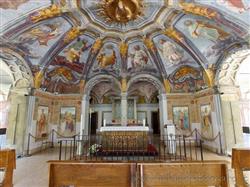
The sacellum, on the lower level, is the oldest part of the complex. It consists of a square room originally open on three sides by double arches, now closed by glass doors. The roof is made of a complex and original dodecagonal vault that uses, on a circular base, the construction principle of ribbed vaults. It is a revival of a construction model drawn directly from ancient Roman architecture. All vertical elements, both internal and external, are separated from the vaults or intrados by a cornice.
Almost all the interior surfaces are decorated with frescoes from the early sixteenth century, likely from the school of Bernardino Luini. The vault depicts the Apostles, with Judas replaced by Saint Paul, separated by busts of sibyls. At the center is a God the Father blessing at the center of a radiant sun, not painted but in gilded wood and stucco.
At the bases of the vault are fanciful monster heads and gold-colored acanthus leaves, creating a mix of sacred and profane elements, a frequent feature of the early Renaissance.
The surfaces of the four corner pillars are covered with rectangular panels, surrounded by a frame of grotesque decorations depicting saints and Gospel figures. Starting from the northeast pillar and moving clockwise, the scenes are: Saint John the Baptist and the Visitation, the Nativity and Saint Roch, the Flight into Egypt and the Visitation, the Annunciation and the Nativity.
The intrados of the entrance arches to the shrine are frescoed, with cherub heads and grotesque decorations inserted within the relief frames.
At the center of the shrine, a few steps below, are the nozzles from which the spring water originally flowed. However, since a century and a half, as explained, water from the municipal aqueduct flows from them.
Behind the altar is a second, rectangular space, which was once the sacristy. Its vault is barrel-vaulted, with rib vaults connecting the walls and the lines connecting the various surfaces, highlighted by simulated moldings. All surfaces are covered with monochrome red grotesque decorations, sometimes with a radiant sun at the center. These are the oldest frescoes in the sanctuary, believed to be about fifteen years older than those in the sacellum.
On the back wall, within a marble frame, is the Madonna of the Fountain, a large canvas depicting the Madonna and Child flanked by the archangels Gabriel and Michael and surrounded by cherubs. Below, on the right, are a grieving Charles d'Amboise with the Father General of the Minims, Matteo da Messina, and on the left, Charles d'Amboise again, healed and accompanied by Saint Francis of Paola.
The canvas is attributed to one of the Campi brothers and is thought to date back to the second half of the sixteenth century.
Externally, the chapel is flanked by two small cloisters, also square, with their southeastern side extending to the front of the chapel. The exterior walls of the chapel have the paneled structure with an arch and an oculus, a feature found in all the older parts. Originally, the exterior walls of the chapel and the vaults of the porticoes were also decorated with frescoes, with a cartouche describing the scene above the frescoes. Unfortunately, these frescoes have been almost completely lost.
If you are interested in a guided tour of this monument send an email!
Categories: Churches / Religious buildings
Piazza Santa Maria alla Fontana, 11
20159 Milano |
Further pictures of the Church of Santa Maria at the Fountain in the section Photography |